How Actual Notice Differs From Constructive Notice in an Arizona Retail Slip and Fall
- What Does Notice Mean in an Arizona Slip and Fall Case?
- What Is Actual Notice in a Retail Slip and Fall?
- What Is Constructive Notice in an Arizona Slip and Fall?
- Why the Length of Time a Hazard Existed Matters
- How Can You Prove Constructive Notice Without Knowing When the Spill Happened?
- What If a Store Employee Created the Dangerous Condition?
- Does Arizona’s Mode-of-Operation Rule Change the Notice Requirement?
- What If the Store Says It Did Not Know About the Spill?
- What Should You Do After a Retail Slip and Fall in Arizona?
- Can You Recover Compensation if You Were Partially Responsible?
- Speak With an Arizona Retail Slip and Fall Attorney
- Actual notice means a store was aware of the specific dangerous condition before an accident.
- Constructive notice means a store should have discovered the hazard through reasonable care, even without direct knowledge.
- Surveillance footage, inspection records, witness statements, and employee reports can help establish notice.
- Arizona recognizes a limited mode-of-operation rule that may eliminate the need to prove actual or constructive notice in certain retail accidents.
- A store’s lack of knowledge does not automatically defeat a claim, but the occurrence of a fall alone does not establish negligence.
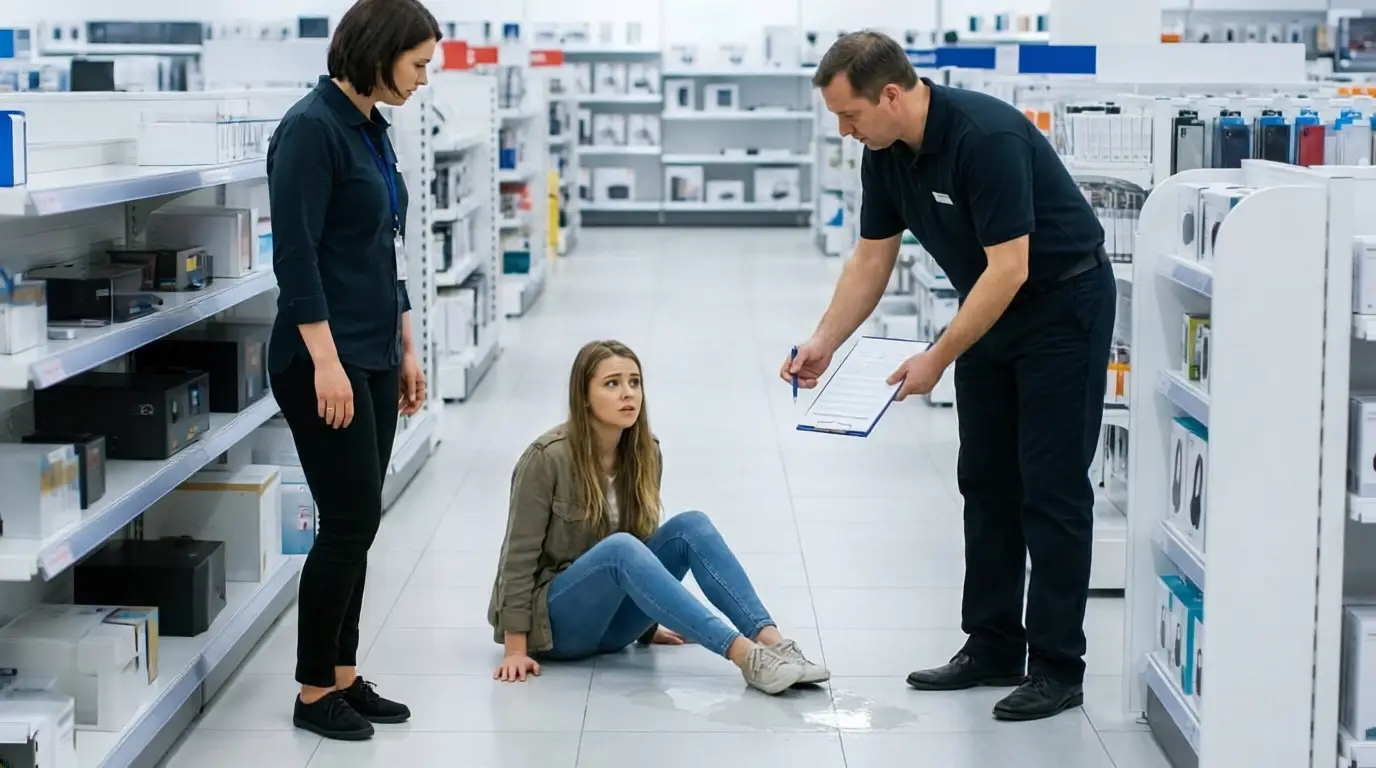
You slip on a puddle in a grocery store, fall hard, and injure your knee. A store manager arrives, helps you to your feet, and completes an incident report. A few days later, the store’s insurance company tells you that the business is not responsible because nobody knew about the spill.
Does that mean you do not have a case?
Not necessarily. Under Arizona law, a retail store may be responsible for injuries caused by a dangerous condition even when its employees claim they were unaware of the hazard.
The important distinction is between actual notice and constructive notice. Actual notice means the store knew about the dangerous condition. Constructive notice means the condition existed long enough that the store should have discovered it through reasonable care.
Understanding this difference can help you recognize what evidence matters in an Arizona slip and fall injury claim and why an insurance company’s initial denial may not tell the whole story.
What Does Notice Mean in an Arizona Slip and Fall Case?
Retail businesses have a duty to exercise reasonable care to maintain reasonably safe premises for their customers. However, they are not automatically responsible for every accident that occurs inside their stores.
For example, a grocery store cannot necessarily prevent a customer from dropping a beverage in an aisle. Whether the store is legally responsible for a subsequent accident depends on the circumstances, including what its employees knew and whether the business had a reasonable opportunity to address the danger.
Under the traditional rules of Arizona premises liability law, an injured customer generally must establish at least one of three circumstances:
- The dangerous condition resulted from the actions of the store or its employees.
- The store had actual notice of the dangerous condition.
- The store had constructive notice because the condition existed long enough that reasonable care should have led to its discovery and correction.
These principles are explained in the Arizona Supreme Court’s decision in Preuss v. Sambo’s of Arizona, Inc.
Each situation presents a different way to establish a store’s potential responsibility. The distinction becomes especially important when nobody can identify exactly how or when the hazard appeared.
What Is Actual Notice in a Retail Slip and Fall?
Actual notice exists when a retail business knows about the specific dangerous condition before the accident.
Consider a customer who notices water leaking from a refrigerated display and informs a store employee. The employee acknowledges the problem but does not clean up the water, block off the area, or provide an adequate warning.
Ten minutes later, another customer slips on the water and suffers a serious injury.
The earlier report may help establish actual notice because the store received information about the specific hazard before the accident.
Actual notice can also arise when an employee personally observes a dangerous condition or when a maintenance worker discovers a problem during an inspection.
What Evidence Can Establish Actual Notice?
Evidence of actual notice may include customer complaints, employee statements, maintenance requests, documented inspections, and internal communications.
For example, a store’s incident records might show that an employee reported a leaking freezer shortly before a customer fell. Surveillance footage might also show an employee examining a spill without taking appropriate action.
These records can be important when the store subsequently claims that nobody knew about the danger.
However, proving knowledge is only part of the analysis. The circumstances must also show that the store failed to exercise reasonable care and that this failure caused the customer’s injuries.
What Is Constructive Notice in an Arizona Slip and Fall?
Constructive notice is different because it does not require proof that an employee actually knew about the hazard.
Instead, the question is whether the dangerous condition existed for a sufficient amount of time that a reasonably careful store should have discovered and addressed it.
Imagine a customer spills a drink in a department store aisle. The liquid remains on the floor while employees work nearby. Several customers walk around the spill, but nobody cleans it up.
Eventually, another customer slips and falls.
Even if the employees deny seeing the liquid, evidence showing how long it remained on the floor may support an argument that the store should have discovered it through reasonable inspections.
Constructive notice does not require a customer to prove that a manager deliberately ignored a problem. It focuses on whether the business exercised reasonable care under the circumstances.
For a more detailed explanation, read our guide on how to prove constructive knowledge of a hazard in an Arizona personal injury case.
Why the Length of Time a Hazard Existed Matters
One of the most important questions in a constructive notice claim is how long the dangerous condition existed before the accident.
Arizona courts have addressed this issue directly.
In McGuire v. Valley National Bank of Phoenix, the Arizona Supreme Court considered an accident involving a pebble on a stairway.
The available evidence did not establish how long the pebble had been there. Without evidence supporting a reasonable conclusion about its duration, a jury would have been left to speculate about whether the property owner had sufficient time to discover and remove it.
The court concluded that speculation was insufficient to establish negligence.
This principle is particularly important in retail accidents because spills and other temporary hazards can develop unexpectedly.
A drink spilled seconds before a fall presents a different situation from liquid that remained on the floor through multiple reasonable opportunities for inspection.
Arizona law does not establish a universal number of minutes that automatically creates constructive notice. The relevant question is whether the condition existed long enough that the business should have discovered and addressed it through reasonable care.
How Can You Prove Constructive Notice Without Knowing When the Spill Happened?
Most injured customers do not know when a spill occurred. They may not even notice the dangerous condition until after they fall.
That does not mean investigating constructive notice is impossible.
Physical evidence, surveillance recordings, inspection records, and witness testimony may help establish the circumstances surrounding the hazard.
Surveillance Footage
Security cameras may reveal when a spill occurred, whether employees walked past it, and how much time passed before the accident.
For example, footage showing a customer dropping a drink 20 minutes before another customer falls could help establish the timeline. The significance of that evidence would depend on the store’s inspection practices and other circumstances.
Store Inspection Records
Retail businesses may maintain cleaning schedules, inspection checklists, or electronic maintenance records.
These records can help determine when employees last inspected the area and whether required inspections were completed.
A documented inspection does not automatically establish that the store acted reasonably. The reliability of the record, the inspection itself, and the surrounding circumstances may all matter.
Witness Statements and Physical Evidence
Other customers may have noticed the hazard before the accident. Employees may also have observed conditions that help establish a timeline.
Photographs showing the appearance of a spill, surrounding debris, or the condition of the floor may provide additional context.
However, physical characteristics alone do not necessarily establish how long a hazard existed. Any conclusion about duration must be supported by the available evidence.
What If a Store Employee Created the Dangerous Condition?
There is another important distinction that injured customers sometimes overlook.
When a store or its employee creates the dangerous condition, proving actual or constructive notice is not necessarily required under the traditional Arizona framework.
For example, an employee might mop a customer walkway and leave it dangerously wet without providing an appropriate warning. Another employee might leave unpacked merchandise in an aisle where customers are expected to walk.
If the employee’s actions created the hazard that caused the injury, the claim may focus on the business’s responsibility for creating the condition rather than how long the condition existed.
It is still necessary to establish negligence, causation, and damages. The fact that an employee was involved does not automatically establish liability.
Does Arizona’s Mode-of-Operation Rule Change the Notice Requirement?
Yes. In certain retail slip and fall cases, Arizona recognizes an exception to the traditional requirement of proving actual or constructive notice.
This exception is known as the mode-of-operation rule.
The rule focuses on how a business operates and whether its chosen method of operation makes certain dangerous conditions regularly foreseeable.
For example, a grocery store may allow customers to select produce from open displays. Depending on the circumstances, the store may reasonably anticipate that customers will occasionally drop items onto the floor.
In Chiara v. Fry’s Food Stores of Arizona, Inc., the Arizona Supreme Court explained that the mode-of-operation rule may apply when a business can reasonably anticipate that its method of operation will regularly produce hazardous conditions.
When the rule applies, an injured customer may not need to establish actual or constructive notice of the specific hazard.
However, this exception has important limitations. The mere possibility that a customer could create a hazard is not enough.
The injured customer must still present evidence supporting the rule’s application and establish that the store failed to exercise reasonable care.
This is why investigating a retailer’s operations can be just as important as determining when a particular spill occurred.
What If the Store Says It Did Not Know About the Spill?
A store’s statement that nobody knew about a hazard should be evaluated alongside the other available evidence.
The business may genuinely have been unaware of a spill. However, that fact does not resolve whether it should have discovered the condition through reasonable care.
An investigation should consider the timing of the accident, available camera footage, employee responsibilities, cleaning procedures, prior reports, and the location of the hazard.
It is also important to distinguish between knowledge of a general risk and notice of the specific condition that caused the injury. Under traditional Arizona notice rules, awareness that spills sometimes occur does not, by itself, establish notice of the particular spill involved in an accident.
Different considerations may apply when the evidence supports the mode-of-operation rule.
Before agreeing to an insurance company’s description of what happened, injured customers should understand which facts have actually been established.
What Should You Do After a Retail Slip and Fall in Arizona?
The actions you take after a retail accident may help preserve evidence relevant to actual notice, constructive notice, and the cause of your injuries.
If you are able to do so safely, photograph the hazard and surrounding area before conditions change. Report the accident to the store and ask for a copy of any incident report the business is willing to provide.
When speaking with employees, describe what you personally observed. Avoid guessing about how long a spill existed or who caused it.
Our article about signing a retail store incident report after a slip and fall explains why accurate documentation matters.
Seek appropriate medical attention and retain records of your treatment, expenses, and missed work.
It may also be important to request preservation of surveillance footage and other relevant records. Retail businesses may not retain video recordings indefinitely, and physical conditions can change quickly after an accident.
Arizona generally provides a two-year statute of limitations for personal injury lawsuits under Arizona Revised Statutes Section 12-542. Different deadlines or exceptions may apply depending on the circumstances.
Investigating the accident promptly can help preserve evidence long before the filing deadline approaches.
Can You Recover Compensation if You Were Partially Responsible?
Even when a store had actual or constructive notice, the insurance company may argue that the injured customer contributed to the accident.
For example, it might claim that the customer was distracted, failed to notice an obvious condition, or ignored an adequate warning.
Arizona follows a comparative negligence system. Under Arizona Revised Statutes Section 12-2505, an injured person’s recovery may be reduced in proportion to their share of fault.
Being partially responsible does not ordinarily eliminate the ability to recover compensation, although the statute includes limitations involving intentional, willful, or wanton conduct.
The relevant circumstances must be examined before determining whether the customer, store, or another party contributed to the accident.
Speak With an Arizona Retail Slip and Fall Attorney
Actual notice and constructive notice may sound like technical legal terms, but they address a practical question: Did the store have a reasonable opportunity to prevent the accident?
The answer often depends on evidence that an injured customer cannot access without further investigation.
At Perez Law Group, PLLC, our Glendale premises liability attorneys help injured customers understand their legal options and investigate whether a property owner’s negligence contributed to their injuries.
If you were injured in a grocery store, department store, shopping center, or another Arizona retail business, our team can review the circumstances of your accident and explain the next steps.
Call Perez Law Group at (602) 730-7100 or visit perezlawgroup.com to schedule a free consultation.
Hablamos Español.
This article provides general information about Arizona premises liability law and is not a substitute for legal advice concerning a specific case.

Cristina Perez Hesano
Founder & Managing Partner
Cristina Perez Hesano is the founding partner of Perez Law Group, PLLC, and an accomplished Arizona trial attorney with more than a decade of experience. She represents individuals and families in serious personal injury, wrongful death, bankruptcy, and consumer protection matters. Known for her compassion, strategic approach, and dedication to justice, Cristina has successfully secured significant results while helping clients navigate some of life’s most difficult challenges.