Landlord Liability for Slippery Common Areas in Arizona Apartment Complexes
- What Does Arizona Law Require Landlords to Do?
- Common Slippery Conditions in Arizona Apartment Complexes
- When Is an Apartment Landlord Liable for a Slip and Fall?
- What If the Apartment Complex Blames a Maintenance Contractor?
- What Should You Do After Slipping in an Apartment Common Area?
- Can You Recover Compensation If You Were Partially at Fault?
- What Compensation Is Available After an Apartment Slip and Fall?
- Frequently Asked Questions About Arizona Apartment Slip and Fall Claims
- Speak With an Arizona Apartment Slip and Fall Lawyer
- Arizona landlords must maintain safe common areas. This includes shared walkways, stairways, hallways, parking areas, and other spaces used by apartment residents.
- A landlord may be liable for a slip and fall injury. Liability may arise when management creates a dangerous condition, knows about a hazard, or reasonably should have discovered and addressed it.
- Maintenance records and prior complaints can help establish negligence. Photographs, surveillance footage, witness statements, and previous repair requests may help demonstrate that a hazardous condition existed before the accident.
- You may still recover compensation if you were partially at fault. Arizona’s comparative negligence law generally allows recovery even when an injured person shares responsibility, although compensation may be reduced according to their percentage of fault.
- Arizona generally allows two years to file a personal injury lawsuit. If you are injured in an apartment common area, seek medical attention, document the hazard, and consider consulting an attorney before important evidence disappears.
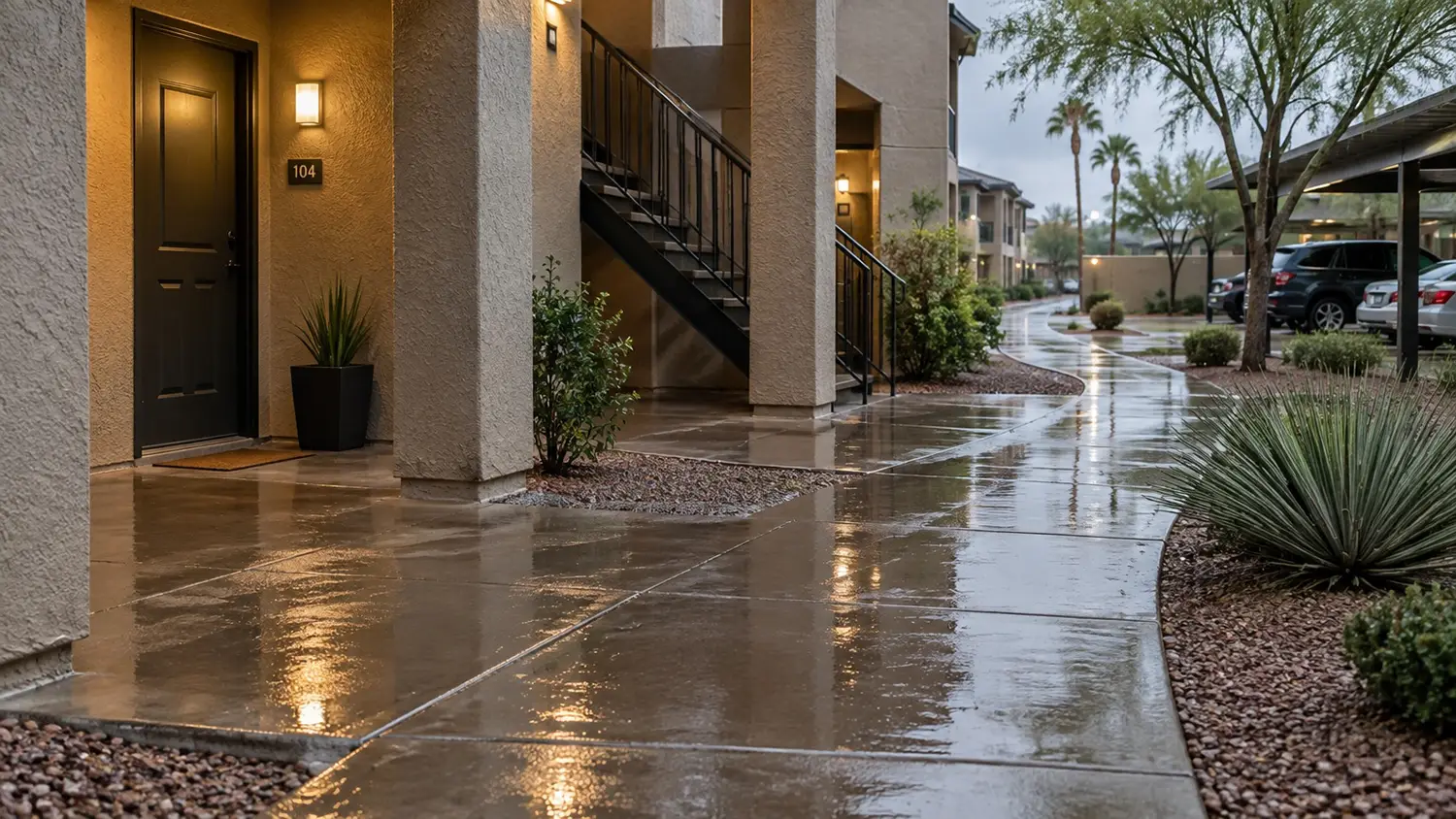
Imagine walking from your apartment to the parking lot after an Arizona monsoon storm. Water has collected on the concrete walkway, and as you turn toward the stairs, your foot slips. You fall, injure your back, and suddenly face medical bills and time away from work.
The property manager might tell you the rain caused the accident or that you should have been more careful. But what if the walkway regularly floods, other residents have complained, or maintenance failed to address a known drainage problem?
An Arizona landlord may be responsible for a slip and fall injury when negligent maintenance of a common area contributes to the accident. Whether you can recover compensation depends on the condition of the property, who controlled it, what the responsible party knew, and the evidence supporting your claim.
Understanding these issues can help you protect your rights after an apartment complex accident.
What Does Arizona Law Require Landlords to Do?
Arizona landlords have a legal responsibility to maintain common areas in a clean and safe condition.
Under Arizona Revised Statutes § 33-1324, landlords must maintain fit premises, address applicable health and safety requirements, and keep shared areas safe for residents.
These responsibilities generally apply to areas maintained for the common use of tenants, including apartment hallways, stairways, shared entrances, and walkways.
The Arizona Supreme Court also addressed landlords’ responsibilities for areas under their control in Siddons v. Business Properties Development Co. Although that case involved a shopping center rather than an apartment complex, the court explained that a landlord retaining control over a shared area has a duty to inspect it and make it reasonably safe.
This does not mean every wet floor or slippery sidewalk automatically creates liability. Landlords must exercise reasonable care, and an injured person generally must establish that the responsible party failed to meet that standard.
Our Glendale premises liability lawyers can help investigate the circumstances surrounding an injury on someone else’s property.
Common Slippery Conditions in Arizona Apartment Complexes
Arizona’s climate creates several maintenance challenges for apartment communities. During monsoon season, sudden storms can leave shared walking surfaces wet. Irrigation systems may also introduce water onto sidewalks that residents use every day.
Some of the most common potential hazards include:
- Wet walkways and entryways: Rainwater, irrigation runoff, leaking pipes, and poor drainage can create slippery surfaces.
- Apartment stairways: Standing water, worn stair treads, loose handrails, or inadequate lighting may contribute to falls.
- Swimming pool decks: Wet surfaces, accumulated algae, or insufficient drainage may create dangerous conditions.
- Laundry rooms and shared bathrooms: Leaking washers, overflowing sinks, and freshly mopped floors without appropriate warnings can present slipping hazards.
- Parking lots and garages: Oil, standing water, and other slippery substances can create risks for pedestrians.
Not every wet surface is unreasonably dangerous. For example, residents should expect some water around swimming pools.
However, if management knows that a walkway becomes dangerously slippery whenever the sprinklers operate and fails to take reasonable corrective action, that recurring condition may support a negligence claim.
When Is an Apartment Landlord Liable for a Slip and Fall?
A successful Arizona premises liability claim generally requires proof of a legal duty, breach of that duty, causation, and actual damages.
One of the most important questions is whether the landlord created the hazard, knew about it, or reasonably should have discovered it.
The Landlord Created the Dangerous Condition
Suppose an apartment maintenance employee mops a shared hallway and leaves the floor excessively wet without an adequate warning. A resident then slips while walking to the elevator.
If the employee’s actions created an unreasonably dangerous condition, the landlord or another responsible party may face liability.
The circumstances matter, including whether the work was performed reasonably and whether a warning would have reduced the risk.
Management Knew About the Hazard
A landlord has actual notice when management or its agents know about a dangerous condition.
For example, several tenants may have reported a leaking irrigation line that regularly floods the entrance to their building.
If management receives those complaints but fails to take reasonable steps to correct the hazard, the reports may help establish that the property owner knew about the danger.
Management Should Have Discovered the Hazard
A landlord cannot necessarily avoid liability simply by claiming nobody reported the problem.
Constructive notice means a dangerous condition existed under circumstances in which reasonable care should have led to its discovery and correction.
A puddle that appeared moments before an accident presents different evidence from a leak that left standing water in the same walkway for several days.
Learn more in our guide to proving constructive knowledge of a hazard in an Arizona personal injury case.
Arizona case law recognizes that a landlord’s responsibility can depend on its control of the premises, its opportunity to discover a hazard, and whether it took reasonable steps to address the danger.
What If the Apartment Complex Blames a Maintenance Contractor?
Some apartment communities hire outside companies to clean floors, maintain landscaping, or repair plumbing.
After an accident, management may argue that a contractor caused the hazard and therefore should be responsible.
The answer depends on who controlled the area, the nature of the work, the parties’ responsibilities, and their respective conduct.
For example, suppose a landscaping contractor repeatedly directs irrigation water onto a heavily used walkway. The contractor’s actions may be relevant, but the apartment owner or management company’s knowledge and maintenance responsibilities may also need investigation.
Hiring an outside contractor does not automatically eliminate a landlord’s responsibility for common areas.
An attorney can examine maintenance agreements, inspection records, incident reports, and other evidence to identify potentially responsible parties.
What Should You Do After Slipping in an Apartment Common Area?
The actions you take after an accident can affect your health and your ability to document what happened.
Seek appropriate medical attention first, especially if you have severe pain, a possible fracture, or symptoms of a head injury.
Once you can safely do so, consider taking these steps:
- Photograph the location, including the slippery surface, nearby drainage, lighting, and any warning signs.
- Report the incident to apartment management and request a copy of any incident report you complete.
- Save previous maintenance requests, emails, text messages, or photographs showing the same hazard.
- Obtain contact information from witnesses who saw your fall or knew about the dangerous condition.
- Request that management preserve relevant security footage, inspection records, and maintenance documentation.
If your apartment uses an online resident portal, save screenshots of prior complaints and their submission dates.
Surveillance footage can be particularly important because it may reveal how long a hazard existed before the accident. Consider having an attorney send a preservation request promptly.
Our article on navigating slip and fall cases explains additional steps that may help protect your claim.
Can You Recover Compensation If You Were Partially at Fault?
Possibly.
An apartment complex’s insurance company might argue that you were distracted, wearing unsuitable footwear, or failed to notice an obvious hazard.
Arizona follows a comparative negligence system. Under A.R.S. § 12-2505, an injured person’s damages generally may be reduced in proportion to their share of fault, rather than being automatically barred because they were partially responsible.
For example, assume your damages total $50,000 and you are assigned 20% of the fault. Your potential recovery could be reduced to $40,000, subject to the other facts and legal issues in your case.
The fact that a slippery condition was visible does not necessarily resolve whether the landlord acted reasonably. The circumstances surrounding the fall still matter.
What Compensation Is Available After an Apartment Slip and Fall?
A serious fall can result in injuries requiring surgery, physical therapy, or prolonged rehabilitation.
Depending on the evidence and the circumstances, compensation may include medical expenses, future treatment costs, lost income, reduced earning capacity, pain and suffering, and other legally recoverable losses.
Broken wrists, hip fractures, herniated discs, and traumatic brain injuries can have significant consequences for a person’s ability to work and manage daily responsibilities.
A proper evaluation should consider both immediate expenses and reasonably supported future losses.
If you suffered a serious injury, our Glendale slip and fall attorneys can help you understand the damages that may be available.
Frequently Asked Questions About Arizona Apartment Slip and Fall Claims
Can a guest sue an apartment landlord after slipping in a common area?
Yes, an invited guest may have a claim if the evidence establishes that a landlord or another responsible party negligently maintained an area under its control.
The Arizona Supreme Court has recognized that a landlord’s duty regarding retained common areas can extend to people lawfully present with a tenant’s consent.
What if my lease says the landlord is not responsible for accidents?
A lease provision does not necessarily prevent a valid injury claim.
Arizona Revised Statutes § 33-1315 prohibits residential rental agreements from requiring tenants to waive certain statutory rights or agree to limitations of a landlord’s liability arising under law. Prohibited provisions are unenforceable.
The specific language and circumstances should be reviewed by an attorney.
How long do I have to file an apartment slip and fall lawsuit in Arizona?
Arizona generally provides a two-year limitations period for personal injury lawsuits under A.R.S. § 12-542. Exceptions and different deadlines may apply in certain circumstances.
It is important to seek legal guidance well before the deadline because evidence may disappear or become harder to obtain.
Speak With an Arizona Apartment Slip and Fall Lawyer
If you were injured because of a slippery walkway, unsafe stairway, leaking pipe, or another dangerous condition at an Arizona apartment complex, you may have grounds to pursue compensation.
At Perez Law Group, PLLC, our personal injury attorneys help people throughout Glendale, Phoenix, the West Valley, and surrounding Arizona communities understand their legal options after preventable injuries.
We can review the circumstances of your accident, investigate potentially responsible parties, and help you determine your next steps.
Call Perez Law Group at (602) 730-7100 to schedule a consultation.
Hablamos Español.
This article provides general legal information and is not a substitute for advice about your specific circumstances.

Cristina Perez Hesano
Founder & Managing Partner
Cristina Perez Hesano is the founding partner of Perez Law Group, PLLC, and an accomplished Arizona trial attorney with more than a decade of experience. She represents individuals and families in serious personal injury, wrongful death, bankruptcy, and consumer protection matters. Known for her compassion, strategic approach, and dedication to justice, Cristina has successfully secured significant results while helping clients navigate some of life’s most difficult challenges.