Should You Sign a Store Incident Report After a Slip and Fall in Arizona?
- What Is a Store Incident Report?
- The Incident Report May Become Evidence Later
- Do Not Guess About Facts You Did Not See
- Be Careful About Saying You Are “Fine”
- Read Everything Before Signing
- What Should You Do After a Store Accident Instead?
- Arizona Businesses Have a Duty to Keep Stores Reasonably Safe
- What If You Already Signed the Incident Report?
- Do Not Let the Store’s Report Become the Only Record of What Happened
- Talk With an Arizona Premises Liability Lawyer
- Report the accident to the store, but stick to facts you actually know.
- Do not guess about how long a spill or hazard existed or why it happened.
- Be cautious about signing statements, releases, medical authorizations, or other documents you have not carefully reviewed.
- Avoid saying you are “fine” simply because you do not yet know the extent of your injuries.
- Take your own photographs and gather witness information rather than relying entirely on the store’s investigation.
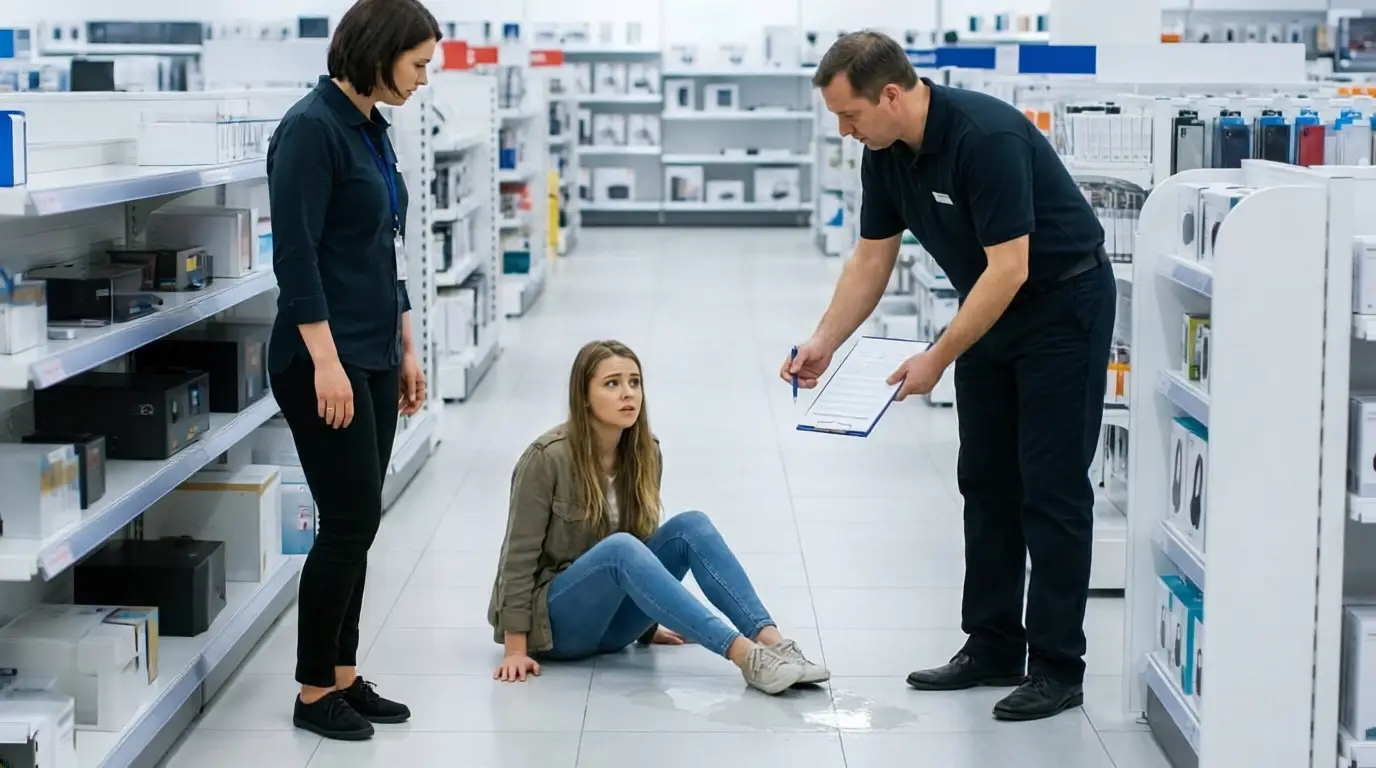
After a slip and fall in a grocery store, department store, restaurant, or other Arizona business, a manager may quickly appear with an incident report.
You may be asked where you fell, what caused the accident, whether you were hurt, what shoes you were wearing, and what you were doing immediately before the fall. Then you may be asked to sign the form.
At that moment, it can feel like routine paperwork.
It may not be.
An incident report can become an important piece of evidence if an injury claim develops. What you write shortly after the accident may later be compared with your medical records, photographs, witness statements, surveillance video, and statements you make to an insurance adjuster.
The problem is not necessarily reporting the accident. In fact, documenting that an accident occurred can be helpful. The bigger risk is signing a statement containing guesses, incomplete information, inaccurate wording, or language you do not fully understand.
What Is a Store Incident Report?
A store incident report is generally an internal document used to record what happened after an accident or unusual event.
A manager may ask for information such as the time and location of the accident, how you believe it happened, whether you noticed the hazard beforehand, whether you were injured, and whether anyone witnessed the incident.
There is nothing inherently wrong with a business documenting an accident. Businesses need records for safety, insurance, and risk management purposes.
However, remember whose document you are completing.
The store’s incident report is not being prepared by an independent investigator on your behalf. It is a company record that may eventually be reviewed by the store’s insurer, claims department, attorneys, or corporate risk management team.
That is why accuracy matters.
The Incident Report May Become Evidence Later
One of the most important things to understand is that statements made immediately after an accident do not necessarily disappear once you leave the store.
Imagine that you slip near the refrigerated section of a supermarket. You are embarrassed, your knee hurts, employees and customers are surrounding you, and a manager asks what happened.
You write:
“I wasn’t watching where I was going and slipped.”
Several days later, surveillance footage may show something more complicated. Perhaps liquid had spread across a walkway. Perhaps there was no warning sign. Perhaps an employee had walked through the area shortly before you fell.
Your original statement can now become part of the dispute.
This is particularly important in Arizona because the state uses comparative negligence. Under Arizona Revised Statutes Section 12-2505, an injured person’s damages may be reduced according to the percentage of fault assigned to that person.
That does not mean you should refuse to cooperate with everyone at the store. It means you should not casually accept responsibility for an accident before you understand what happened.
Do Not Guess About Facts You Did Not See
After a fall, managers sometimes ask questions that an injured customer simply cannot answer.
“How long was the water there?”
“Where did it come from?”
“Why didn’t you see it?”
“Were you distracted?”
If you do not know, say you do not know.
Suppose you noticed a puddle only after falling. You may know that the floor was wet, but you probably do not know whether the liquid had been there for 30 seconds or 30 minutes.
Those are different facts.
Guessing can create unnecessary problems because premises liability cases often depend on evidence about the dangerous condition, how it developed, what employees knew, what inspections occurred, and whether reasonable steps were taken to correct the hazard or warn customers.
Perez Law Group discusses these issues in more detail on our Glendale premises liability lawyer page.
Be Careful About Saying You Are “Fine”
Another common mistake happens when the incident report asks whether the customer was injured.
Immediately after falling, you may genuinely believe the injury is minor.
That does not necessarily mean it is.
Pain, stiffness, swelling, headaches, numbness, or other symptoms may become more noticeable after you leave the store. Some people also minimize their condition because they are embarrassed or simply want to go home.
There is an important difference between saying, “I am not injured,” and saying, “I am not sure yet. My knee hurts and I need to see how I feel.”
Describe what you actually know at that moment.
If you are experiencing pain or other symptoms, do not minimize them just to finish the paperwork.
Read Everything Before Signing
The signature line deserves particular attention.
Before signing anything, determine exactly what you are signing.
A document presented after an accident could be nothing more than an acknowledgment that you reported the incident. It could also contain additional statements about how the accident occurred, your physical condition, authorization to obtain information, or other language you did not expect.
Do not assume every document presented by a manager is simply an “incident report.”
Read it.
If you do not understand the document or believe it inaccurately describes what happened, there is no reason to rush into signing it simply because a store employee wants the paperwork completed.
You can also ask for a copy of anything you complete or sign.
What Should You Do After a Store Accident Instead?
The minutes after an accident can produce evidence that may be impossible to recreate later.
If your condition allows, focus on preserving objective information:
- Photograph the exact area where you fell, including the floor, spill, merchandise, lighting, warning signs, mats, shelving, and surrounding area.
- Get the names and contact information of people who witnessed the fall or saw the hazardous condition.
- Identify the manager or employee to whom you reported the accident.
- Save the shoes and clothing you were wearing instead of throwing them away.
- Seek appropriate medical attention and describe your symptoms accurately.
You can learn more about evidence in these cases through Perez Law Group’s Arizona slip and fall lawyer page.
One additional step is particularly important in retail cases: surveillance video.
Many businesses operate security cameras, but video retention policies vary. Relevant footage could potentially show the fall, the condition of the area beforehand, employees walking through the location, cleanup activity, or when warning signs were placed.
That makes early preservation of evidence important.
Arizona Businesses Have a Duty to Keep Stores Reasonably Safe
A customer does not automatically have a successful injury claim simply because an accident happened inside a store. The facts surrounding the dangerous condition and the store’s conduct still matter.
However, Arizona law recognizes an important duty owed to customers.
In the 2025 case Perez v. Circle K Convenience Stores, Inc., the Arizona Supreme Court held that a business owes customers a duty to keep its premises reasonably safe. The Court explained that even when a condition may have been open and obvious, that does not automatically eliminate the business’s duty. Whether the business acted reasonably remains a separate question.
That decision is particularly relevant in retail accident cases because stores sometimes argue that a customer simply should have noticed a box, display, spill, obstruction, or other condition.
Arizona premises liability law can involve more than that single question.
What If You Already Signed the Incident Report?
Do not assume your case is over.
Signing an incident report does not automatically determine who was responsible for an accident.
The report is one piece of evidence.
Photographs, surveillance footage, employee testimony, witness statements, maintenance records, inspection procedures, medical documentation, and other evidence may provide a much fuller picture of what occurred.
Your attorney can also examine the circumstances under which the statement was made and compare what was written with the remaining evidence.
The important thing is to tell your lawyer exactly what happened, including everything you remember writing or signing.
Do Not Let the Store’s Report Become the Only Record of What Happened
This may be the most important lesson.
The store will likely document the accident from its perspective.
You should document it from yours.
Take photographs. Save relevant evidence. Write down what happened while your memory is fresh. Record the names of employees and witnesses. Seek medical attention when necessary.
The danger is not simply “signing an incident report.” The greater danger is allowing a company’s internal paperwork to become the most detailed record of the accident while you leave with nothing of your own.
Talk With an Arizona Premises Liability Lawyer
Retail slip and fall cases can quickly become disputes about what caused the accident, how long a dangerous condition existed, whether employees knew about it, whether adequate warnings were provided, and whether the injured customer shares any responsibility.
Evidence can disappear while those questions are being investigated.
Arizona also generally provides a two-year limitations period for many personal injury actions under Arizona Revised Statutes Section 12-542, although different deadlines and exceptions may apply depending on the circumstances.
If you were seriously injured at a grocery store, department store, restaurant, shopping center, or another Arizona business, Perez Law Group, PLLC can review what happened and explain your options.
Our attorneys represent injured clients throughout Glendale, Phoenix, the West Valley, and communities across Arizona.
Call Perez Law Group, PLLC at (602) 730-7100 to schedule a consultation.
Hablamos Español.
This article provides general information and is not a substitute for legal advice about a specific case.

Cristina Perez Hesano
Founder & Managing Partner
Cristina Perez Hesano is the founding partner of Perez Law Group, PLLC, and an accomplished Arizona trial attorney with more than a decade of experience. She represents individuals and families in serious personal injury, wrongful death, bankruptcy, and consumer protection matters. Known for her compassion, strategic approach, and dedication to justice, Cristina has successfully secured significant results while helping clients navigate some of life’s most difficult challenges.