Gathering Proof That A Lane Merge Was Executed Unsafely
- What Does Arizona Law Say About Changing Lanes?
- What Evidence Can Prove an Unsafe Lane Merge?
- A Hypothetical Example: When the Damage Tells a Different Story
- What If Both Drivers Are Accused of Contributing to the Accident?
- Do Not Focus Only on Proving Fault
- The Most Important Evidence May Be the Evidence That Disappears First

- Arizona drivers generally must determine that a lane change can be made safely before moving from their lane.
- Scene photographs should document the roadway and merge area, not just vehicle damage.
- Dashcam, surveillance, and commercial vehicle video should be identified quickly because recordings may be lost or overwritten.
- Damage patterns, independent witnesses, police records, and electronic vehicle data may help clarify how a disputed merge occurred.
- Arizona’s comparative fault rules make accurate evidence especially important when an insurer claims both drivers contributed to the accident.
A lane merge accident can happen in seconds, but proving exactly what happened may take much more work.
One driver may say, “I was already in the lane.” The other may insist, “They cut me off.” With no traffic light or obvious right-of-way violation to point to, an insurance company may treat the accident as a simple disagreement between two drivers.
That does not mean the truth cannot be established.
In an Arizona lane merge accident, some of the most useful evidence may include photographs of the roadway and vehicle damage, dashcam or surveillance video, independent witnesses, the police report, vehicle data, and the physical location of the collision.
The key is to gather that evidence before it disappears.
What Does Arizona Law Say About Changing Lanes?
Arizona law places responsibility on a driver to make sure a lane movement can be completed safely.
Under Arizona Revised Statutes Section 28-729, a driver on a roadway with clearly marked lanes generally must remain within a single lane and cannot move from that lane until the driver has first determined that the movement can be made safely.
Arizona Revised Statutes Section 28-754 also states that a driver should not move right or left on a roadway unless the movement can be made with reasonable safety. When other traffic may be affected, an appropriate signal is also required.
Those rules make an important point in a personal injury case. The question is not simply which vehicle was technically ahead. The investigation may need to determine whether the merging driver looked for surrounding traffic, left sufficient space, signaled, maintained control, and completed the movement safely.
What Evidence Can Prove an Unsafe Lane Merge?
At Perez Law Group, we believe disputed crashes should be evaluated through evidence rather than simply accepting whichever driver’s story sounds more convincing.
The strongest lane merge cases often tell the same story in several different ways.
The roadway tells part of the story. The damage to the vehicles tells another part. Video, witnesses, electronic data, and police observations may provide additional pieces.
When those pieces are consistent, they can make it much harder for an insurance company to dismiss the collision as one driver’s word against another’s.
1. Photograph the Exact Merge Area
Photographs should show more than the damaged bumper.
If you can safely do so, photograph the area where the vehicles were traveling before impact. Important details may include:
- Lane markings and the location where lanes begin to merge
- Traffic signs and pavement markings
- Construction barriers or cones
- The length of the merge area
- Vehicle positions after the collision
- Debris, tire marks, fluid, or other physical evidence
- Damage to both vehicles
Take wide photographs as well as closer images.
A close photograph of a damaged door may be useful, but a wide photograph showing that vehicle sitting next to a disappearing lane may provide important context that the damage photograph cannot.
If you were unable to take photographs at the scene because you were injured, someone may be able to return to the location later. Road conditions can change, however, particularly in construction zones, so earlier documentation is generally more useful.
2. Look Closely at Where the Vehicles Were Damaged
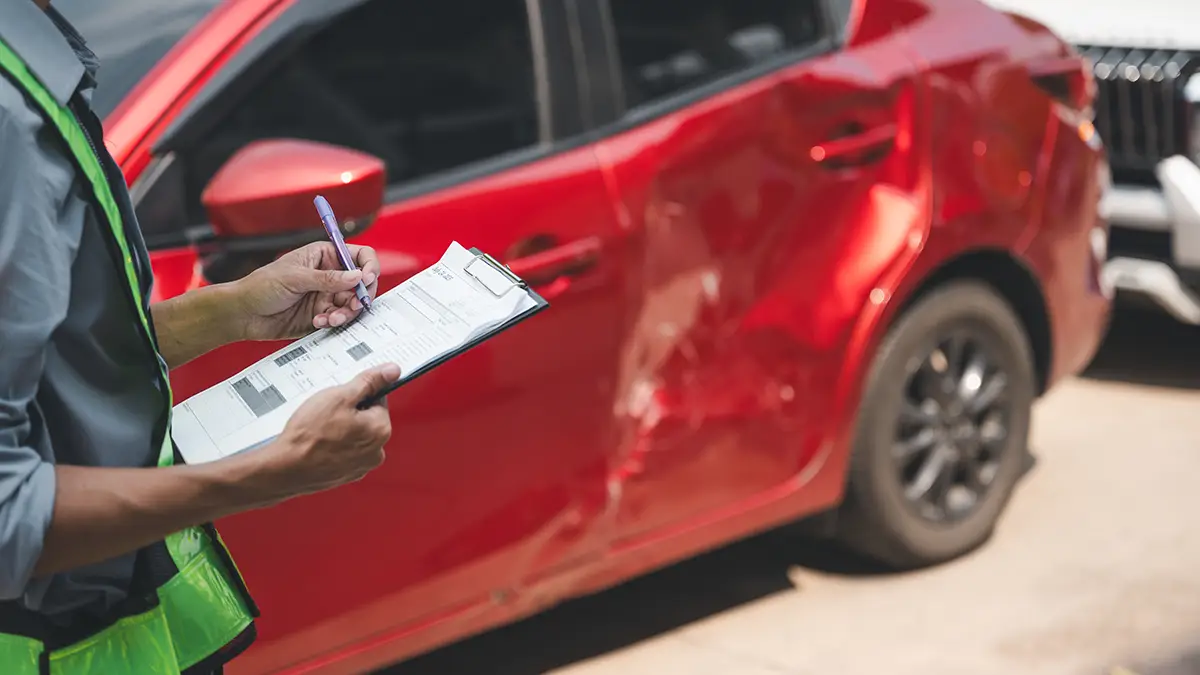
The location and direction of vehicle damage can sometimes help investigators understand how a collision occurred.
For example, imagine that another driver claims you drove into the side of their vehicle while changing lanes. But your vehicle has damage concentrated along the driver’s side rear quarter panel while the other vehicle has front passenger-side damage.
That damage pattern deserves closer examination.
It does not automatically establish fault. Vehicle movement during a collision can be complicated. But the points of impact may help determine which vehicle was moving laterally, which vehicle was farther into the lane, and how the vehicles came together.
This is one reason Perez Law Group’s approach to a disputed car accident is to look beyond the initial insurance narrative. Our Phoenix car accident lawyers may review photographs, repair information, crash reports, video, witnesses, and other available evidence when investigating liability.
3. Find Video Before It Is Deleted
Video can completely change a disputed lane merge claim.
Potential sources include dashcams, Tesla or other vehicle cameras, commercial truck cameras, nearby businesses, residential security cameras, parking lot cameras, and cameras mounted on buses or other commercial vehicles.
The problem is that video does not necessarily remain available indefinitely.
A business may overwrite security footage automatically. A vehicle recording may be erased or recorded over. A camera that appeared to be facing the roadway may not have been recording at all.
That is why identifying possible video sources quickly can matter.
If a nearby gas station, restaurant, shopping center, apartment complex, or business has a camera pointed toward the roadway, note the business name and location. An attorney may be able to contact the owner and request that potentially relevant footage be preserved.
Our Arizona negligence attorneys understand why evidence preservation can become important because surveillance video, vehicle information, and other records may disappear or be overwritten.
4. Independent Witnesses Can Be Extremely Valuable
An independent witness does not necessarily know who legally caused the accident.
That is okay.
What matters is what the person actually saw.
A witness might remember that one vehicle suddenly crossed two lanes. Another might have seen a driver merge without signaling. Someone behind the vehicles may have noticed that the merging driver nearly struck another vehicle moments before the collision.
If witnesses stop at the scene, get their names and contact information when possible.
Do not simply rely on the police officer having collected everything. If you have a witness’s information, preserve it yourself as well.
5. Obtain the Police Report and Related Records
A police report does not automatically decide who wins an insurance claim or lawsuit, but it may contain useful information.
Depending on the investigation, the report may identify drivers and witnesses, show a crash diagram, describe vehicle positions, document statements made at the scene, identify citations, or include an officer’s observations.
If the collision was investigated by the Arizona Department of Public Safety on an interstate or state highway, DPS provides a process for requesting collision reports and related records. For accidents on city, county, or town roads, records generally need to be requested from the local law enforcement agency that investigated the crash. Learn more through the Arizona Department of Public Safety records request process.
Do not overlook photographs or video held by law enforcement. DPS, for example, identifies collision photographs, dash camera footage, body-worn camera footage, and certain other records among the materials that may be available through its records request system.
6. Vehicle Data May Provide Another Piece of the Puzzle
Modern vehicles can contain electronic information that becomes useful in serious or heavily disputed crashes.
An Event Data Recorder, sometimes referred to as an EDR, can record certain technical vehicle information for a short period surrounding a crash.
According to the National Highway Traffic Safety Administration, EDR information may include pre-crash vehicle dynamics, driver inputs, vehicle crash information, and restraint system information. NHTSA also cautions that EDR information has limitations and should be considered with other evidence.
Not every vehicle records the same information, and an EDR will not necessarily answer the specific question of who crossed a lane line.
However, in the right case, vehicle data may help an accident reconstruction specialist evaluate speed, braking, vehicle movement, or other circumstances surrounding the collision.
Commercial vehicles may also have additional sources of evidence, such as GPS information, telematics, driver logs, or fleet camera systems.
A Hypothetical Example: When the Damage Tells a Different Story
Consider this situation.
A driver is traveling north in the center lane of a Phoenix freeway. Another vehicle enters from an on-ramp and begins moving left. The vehicles collide.
The merging driver tells the insurance company that the other driver accelerated and refused to let them enter.
At first, the claim appears to be a disagreement.
Then additional evidence is collected.
A dashcam from a vehicle traveling behind them shows the merging vehicle crossing the lane line when there was little space available. Photographs show damage to the merging vehicle’s front driver’s-side corner and damage beginning near the rear passenger-side door of the vehicle already traveling in the lane. A witness also remembers the merging vehicle entering abruptly.
No single piece of evidence necessarily tells the entire story.
Together, however, the evidence creates a much clearer picture of how the collision happened.
This example is hypothetical and does not predict the outcome of any actual case. It demonstrates why preserving several different forms of evidence can be important.
What If Both Drivers Are Accused of Contributing to the Accident?
Lane merge claims can become complicated because an insurance company may accuse both drivers of making mistakes.
Perhaps the merging driver entered without enough room, but the insurer argues that the other driver was speeding. Maybe one driver claims the other accelerated to prevent the merge.
Arizona’s comparative fault law makes those arguments important.
Under Arizona Revised Statutes Section 12-2505, an injured person’s claim is not necessarily barred because the person shares some fault. Damages may instead be reduced according to the percentage of fault attributed to the claimant.
That makes evidence particularly important in a disputed merge accident. Even a shift in how fault is allocated can affect the amount of compensation ultimately recovered.
Do Not Focus Only on Proving Fault
Proving the other driver made an unsafe merge is only one part of a personal injury claim.
You also need evidence connecting the collision to your injuries and losses.
Medical records, diagnostic imaging, photographs of injuries, lost-wage documentation, treatment records, and a consistent description of how your symptoms developed can all become important.
If your vehicle has relatively little visible damage, that does not necessarily establish that your injuries are minor. Our article on serious injuries when a car has little damage explains why property damage and medical injury should be evaluated as separate pieces of evidence.
Similarly, if you initially told police that you felt fine but developed symptoms later, read our guide on what happens if you said you were fine after a car accident.
The Most Important Evidence May Be the Evidence That Disappears First
After an unsafe lane merge accident, it is easy to concentrate on the insurance claim, repair estimate, and medical appointments.
But some of the most valuable liability evidence may have a much shorter life.
A surveillance recording could be overwritten. A commercial vehicle may return to service. Cars may be repaired or sold. Witnesses may become difficult to find. The roadway itself may change.
That is why early investigation can matter.
Perez Law Group, PLLC investigates car accident claims throughout Phoenix, Glendale, the West Valley, and communities across Arizona. If another driver caused your accident by merging or changing lanes unsafely, our team can examine the available evidence, deal with the insurance companies, and determine what additional investigation may be appropriate.
Learn more about working with a Glendale car accident attorney or contact Perez Law Group, PLLC at (602) 730-7100 for a consultation.
Hablamos Español.
This article provides general information and is not legal advice. Every accident and injury claim depends on its specific facts, available evidence, applicable law, and deadlines.

Cristina Perez Hesano
Founder & Managing Partner
Cristina Perez Hesano is the founding partner of Perez Law Group, PLLC, and an accomplished Arizona trial attorney with more than a decade of experience. She represents individuals and families in serious personal injury, wrongful death, bankruptcy, and consumer protection matters. Known for her compassion, strategic approach, and dedication to justice, Cristina has successfully secured significant results while helping clients navigate some of life’s most difficult challenges.