What Does Uninsured Motorist Coverage Not Pay For in Arizona?
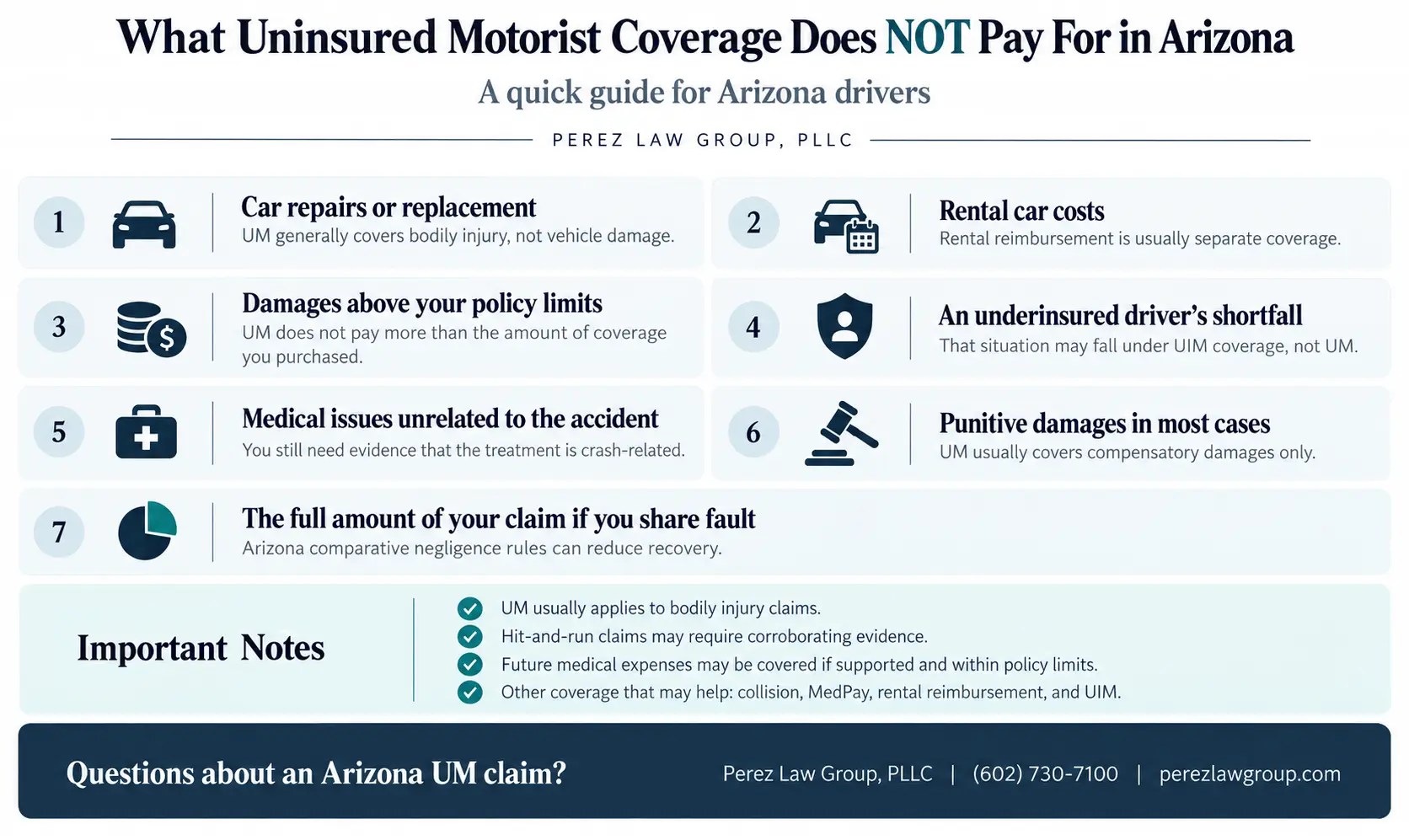
- Arizona UM coverage generally pays for qualifying bodily injuries, not vehicle repairs or other property damage.
- UM coverage does not provide unlimited compensation. Your applicable per-person and per-accident policy limits still matter.
- If the at-fault driver has liability insurance but insufficient limits, UIM coverage may apply instead.
- Medical Payments coverage, collision insurance, and rental reimbursement are separate coverages that may help with expenses UM does not pay.
- Not every claim denial is valid. Arizona law limits certain insurance exclusions and requires insurers to address qualifying claims.
Uninsured motorist (UM) coverage can provide important financial protection when another driver causes an accident and does not have automobile liability insurance. However, many Arizona drivers are surprised to learn that UM coverage does not pay for every expense associated with a car accident.
For example, your uninsured motorist coverage generally will not pay to repair your vehicle, cover rental car expenses, or compensate you for injuries that exceed your available policy limits. It also works differently from underinsured motorist (UIM) coverage, which applies when the responsible driver has insurance but not enough to cover your injuries.
Under Arizona Revised Statutes § 20-259.01, UM coverage is designed to address qualifying bodily injury and death claims. Knowing what your policy does and does not cover can help you avoid unexpected expenses and make informed decisions after an accident.
At Perez Law Group, PLLC, we help injured individuals and families in Glendale, Phoenix, and throughout Arizona understand their insurance coverage, evaluate their injuries, and pursue available compensation. Here is what you should know before filing an uninsured motorist claim.
1. UM Coverage Does Not Pay to Repair or Replace Your Vehicle
One of the biggest misconceptions about uninsured motorist coverage is that it will repair your vehicle when an uninsured driver causes a collision.
In Arizona, standard UM coverage addresses bodily injuries and death. It does not pay for damage to your car, motorcycle, or other personal property.
Suppose an uninsured driver runs a red light in Glendale and strikes your vehicle. You suffer a back injury, and your car sustains $8,000 in damage.
Your UM coverage may apply to your injury claim, but it does not pay the $8,000 vehicle repair bill.
For vehicle repairs, you would generally look to your own collision insurance, if purchased. Your collision deductible may apply. The Arizona Department of Insurance and Financial Institutions (DIFI) explains how these coverages differ.
If you do not carry collision coverage, recovering your property damage may require pursuing the responsible driver directly or investigating another applicable source of coverage.
2. UM Coverage Does Not Automatically Pay for a Rental Car
A damaged vehicle can create immediate problems. You may need transportation to get to work, attend medical appointments, pick up your children, or handle everyday responsibilities.
Unfortunately, UM coverage generally does not pay for a temporary rental vehicle while your car is being repaired.
Rental reimbursement is a separate, optional type of automobile insurance coverage. It may cover an eligible rental expense after a covered collision or comprehensive loss, subject to your policy’s daily and overall limits.
Before renting a vehicle, check your policy and ask your insurer whether rental reimbursement is available. Keep receipts and records of any additional transportation expenses.
3. UM Coverage Does Not Pay More Than Your Available Policy Limits
Your UM coverage may be considerably less than the full value of your injuries.
For example, imagine you have $50,000 in applicable UM coverage but suffer injuries resulting in $85,000 in recoverable damages.
Even if the uninsured driver is entirely responsible, your UM policy generally will not provide more than its applicable limits. The remaining $35,000 does not automatically become your insurance company’s responsibility.
Arizona also allows insurers to limit certain combinations of UM coverage from multiple policies. The rules depend on the policy language and how the coverage was purchased.
However, exceeding your UM limits does not necessarily mean you have exhausted every potential recovery option.
Our related article, What Happens If Your Arizona Uninsured Motorist Claim Exceeds Policy Limits?, explains how additional insurance, other responsible parties, and medical coverage may affect your options.
4. UM Coverage Does Not Replace Underinsured Motorist Coverage
An uninsured driver and an underinsured driver are not the same thing.
If the responsible driver carries liability insurance that meets Arizona’s legal requirements but does not have enough coverage to pay your damages, that situation generally falls under underinsured motorist coverage.
For example, suppose a driver causes a serious collision and has $25,000 in applicable bodily injury liability coverage. Your total damages are $100,000.
Your UM coverage generally will not pay the difference simply because the driver’s insurance is inadequate. Applicable UIM coverage may address damages exceeding the available liability limits.
Arizona law specifically treats UM and UIM as separate coverages and does not permit UIM coverage to be added to UM coverage for the same uninsured motorist claim.
Review your declarations page to determine whether you purchased both types of protection.
5. UM Coverage Does Not Pay for Injuries Unrelated to the Accident
UM coverage may compensate you for accident-related medical expenses, lost income, pain and suffering, and reasonably supported future medical needs.
But it does not automatically pay for every medical condition you have.
If you suffered a back injury before the collision, your insurer may question whether your current treatment is related to the accident or your previous condition.
That does not mean a pre-existing condition automatically disqualifies you. If the collision aggravated an existing injury, the additional harm may be compensable.
The important question is what changed because of the accident.
Our article about car accidents and pre-existing conditions explains why accurate medical records and documentation of your symptoms matter.
Additionally, UM coverage is not the same as health insurance or Medical Payments coverage. It generally provides compensation through a bodily injury claim rather than automatically paying each medical bill as treatment occurs.
6. UM Coverage Generally Does Not Pay Punitive Damages
There is an important difference between compensatory damages and punitive damages.
Compensatory damages address the losses an injured person experiences. Punitive damages are intended to punish particularly wrongful conduct and discourage similar behavior.
In State Farm Mutual Automobile Insurance Co. v. Wilson, the Arizona Supreme Court determined that UM and UIM insurers are not required to pay punitive damages unless they have specifically contracted to provide that coverage.
If a drunk or reckless uninsured driver causes your injuries, UM coverage may still apply to qualifying compensatory damages. The seriousness of the other driver’s conduct does not automatically make punitive damages payable under your UM policy.
7. UM Coverage Does Not Automatically Pay the Full Claim If You Share Responsibility
Your own involvement in the accident may affect the amount you can recover.
Arizona follows a comparative negligence system. Under A.R.S. § 12-2505, recoverable damages can generally be reduced according to the percentage of fault attributed to the injured person.
Suppose your total damages are $40,000, but the evidence establishes that you were 25% responsible for the collision. Your recoverable damages could be reduced to $30,000.
That does not mean an insurance adjuster’s initial allegation of shared fault is necessarily correct. Accident reports, photographs, witness statements, and other evidence may be important when responsibility is disputed.
What About Hit-and-Run Accidents?
A hit-and-run accident may qualify for UM benefits even when the responsible driver cannot be identified.
However, Arizona has an important evidence requirement.
If an unidentified vehicle causes an accident without physically contacting your vehicle, Arizona law requires corroborating evidence that supports your account of what happened. This might include an eyewitness, dashcam footage, or other confirming evidence.
The absence of physical contact does not automatically eliminate UM coverage.
For example, if an unknown driver forces you off the road and disappears, your insurer should not reject an otherwise qualifying claim solely because the vehicles never touched. However, the statutory corroboration requirement must be addressed.
What Should You Do If Your Insurance Company Denies a UM Claim?
Receiving a denial from your own insurance company can be frustrating, particularly when you have been paying for uninsured motorist protection.
Before accepting the insurer’s explanation, consider whether the denial is based on an actual coverage limitation, an incomplete investigation, or a dispute about your injuries.
Ask for the specific policy language supporting the decision and retain all insurance correspondence.
It is also important to understand any medical liens or reimbursement obligations before settling your claim. A UM settlement does not necessarily eliminate outstanding medical expenses or valid reimbursement rights.
Learn more about medical liens after an Arizona car accident and why they can affect your final recovery.
If your insurer disputes the extent of your injuries or refuses to pay available benefits, an attorney can review the policy, medical evidence, and reasons for the denial.
Can You Recover Compensation for Future Medical Treatment Through UM Coverage?
Yes. Qualifying future medical expenses may be included in a UM bodily injury claim when supported by the medical evidence and subject to available coverage limits.
For example, if your physician expects you to need additional physical therapy or surgery, those anticipated costs may affect the value of your claim.
However, UM coverage does not automatically remain open to pay for treatment indefinitely after you settle.
Our article, Who Pays for Future Medical Treatment After a Car Accident?, explains why future needs should be evaluated before accepting a settlement.
Speak With Perez Law Group About Your Arizona Uninsured Motorist Claim
Being injured by an uninsured driver can leave you dealing with medical expenses, missed work, vehicle repairs, and uncertainty about your financial recovery.
Understanding what UM coverage does not pay for is an important first step, but every accident involves different facts and insurance policies.
At Perez Law Group, PLLC, our Glendale car accident attorneys help injured individuals investigate available insurance, document their damages, and evaluate potential sources of compensation.
If you have questions about an uninsured motorist claim, contact Perez Law Group at (602) 730-7100 to schedule a free consultation.
We serve clients throughout Glendale, Phoenix, the West Valley, and communities across Arizona. Hablamos Español.

Cristina Perez Hesano
Founder & Managing Partner
Cristina Perez Hesano is the founding partner of Perez Law Group, PLLC, and an accomplished Arizona trial attorney with more than a decade of experience. She represents individuals and families in serious personal injury, wrongful death, bankruptcy, and consumer protection matters. Known for her compassion, strategic approach, and dedication to justice, Cristina has successfully secured significant results while helping clients navigate some of life’s most difficult challenges.