Injured After Swerving to Avoid Another Driver in Arizona: Can You Claim Without Contact?
- What Is a No-Contact Crash?
- Start With Whether the Other Driver Can Be Identified
- What Does Arizona’s Corroboration Rule Require?
- Evidence to Preserve After Swerving to Avoid Another Vehicle
- What If the Insurer Says You Overreacted?
- Keep the Injury Claim Separate From Vehicle Repairs
- Do Not Assume Every Claim Has the Same Deadline
- Frequently Asked Questions
- Discuss Your No-Contact Crash With Perez Law Group

- The absence of contact with another vehicle does not automatically prevent an Arizona injury claim. The evidence must still establish the legal basis for recovery.
- A claim involving an identified driver and a claim involving an unknown driver require different insurance investigations.
- Arizona law requires corroboration for certain UM or UIM bodily injury claims involving an unidentified vehicle when there was no physical contact with that vehicle.
- Corroboration means additional information supporting your account. Repeating your own account to a police officer is not, by itself, the additional evidence required.
- Satisfying the corroboration requirement does not automatically establish coverage, fault, damages, or a right to payment.
You steer away from a vehicle entering your lane, avoid that vehicle, and crash. The other driver continues down the road. Now you are injured, but there is no damage showing that the two vehicles touched.
You may still have an injury claim in Arizona. Physical contact with the driver who caused the danger is not always necessary. What matters is how the crash happened, whether another driver legally caused your injuries, what insurance applies, and whether you can provide the evidence required for your particular claim.
When the other vehicle is unidentified, Arizona has a specific corroboration rule for certain uninsured and underinsured motorist claims. Understanding that rule can help you avoid two mistaken conclusions: that no contact means no claim, or that describing an unknown driver automatically establishes a covered claim.
What Is a No-Contact Crash?
In this article, a no-contact crash means an accident in which the vehicle alleged to have caused the danger did not physically touch the injured person’s vehicle. Your car might still strike a guardrail, another vehicle, or another object during the event.
An unidentified vehicle that allegedly causes an accident without contact is sometimes called a “miss-and-run” vehicle. The Arizona Court of Appeals uses that terminology in Scruggs v. State Farm Mutual Automobile Insurance Co., a case addressing the corroboration requirement.
The label does not establish who was responsible. It identifies the factual problem that needs to be investigated: what caused the evasive movement and the resulting injury?
Start With Whether the Other Driver Can Be Identified
When You Know Who the Driver Was
If the other driver can be identified, investigate a negligence claim and that driver’s applicable liability insurance. A negligence claim requires a duty of care, a breach of that duty, a causal connection to the injury, and actual damages. Those elements are explained in Gipson v. Kasey, paragraph 9.
For a lane-change incident, A.R.S. § 28-729(1) generally requires a driver on a roadway with clearly marked lanes to determine that leaving the lane can be done safely. But identifying a potentially unsafe movement is only part of the analysis. The evidence must connect that conduct to your crash and injuries.
Document the other vehicle’s movement, where your vehicle was, and what happened next. Avoid guessing about speed, distance, or a driver’s intentions when you do not know.
PLG’s guide to proving an unsafe lane merge discusses the broader investigation of disputed lane changes. A no-contact claim adds the question of how to establish another vehicle’s role without an impact between those vehicles.
When the Driver Cannot Be Identified
If the driver remains unknown, uninsured motorist coverage—often called UM coverage—deserves review. Do not assume that you purchased it merely because you have automobile insurance. Arizona requires insurers to offer UM coverage in the circumstances described by A.R.S. § 20-259.01(A); the declarations and policy documents should show the coverage selected.
For an unidentified vehicle with no physical contact, subsection M adds an evidence requirement. That rule applies to bodily injury or death claims under UM or UIM coverage fitting the statute’s conditions. It does not turn every single-vehicle crash into an uninsured motorist claim.
What Does Arizona’s Corroboration Rule Require?
Under A.R.S. § 20-259.01(M), the insured must provide corroboration that the unidentified vehicle caused the accident when the specified no-contact circumstances apply.
In practical terms, corroboration is additional testimony, a fact, or other evidence that supports and strengthens the insured’s account. It must add something beyond the insured’s own description.
The rule is important because there may be no other driver available to interview and no impact damage linking the vehicles. However, the statute does not say that a video recording is the only acceptable proof. Nor should someone assume that the absence of a witness who saw the entire event necessarily ends the inquiry.
A Police Report May Contain More Than One Kind of Information
Report what happened accurately, but distinguish your statement from independent observations recorded by the officer.
In Scruggs, the driver’s statement to the investigating officer did not qualify as the additional corroboration simply because it was made at the scene. It remained the driver’s own account. By contrast, the court found that an accident reconstruction specialist’s affidavit and report supported the driver’s description through an analysis of the damage pattern.
The lesson is not that every claimant needs an expert. It is that the substance of the evidence matters. A report that only repeats your description is different from a report documenting other observations or analysis that supports it. See Scruggs, paragraphs 18–25.
Corroboration Is Not the Same as Winning the Claim
Even sufficient corroboration does not resolve every coverage or liability issue. In Progressive Classic Insurance Co. v. Blaud, paragraphs 19–20, the court distinguished satisfying the statutory requirement from establishing coverage under the policy.
The insurer or factfinder may still evaluate what caused the accident, whether the policy applies, and the injuries and losses being claimed. Preserve evidence for those questions as well as for corroboration.
Evidence to Preserve After Swerving to Avoid Another Vehicle
Focus on information that could help someone reconstruct the sequence—not just photographs of the final resting position of your car. The following checklist is an investigation aid, not a promise that any one item satisfies the legal standard.
| Information to preserve | Question it may help investigate |
|---|---|
| Original dashcam footage, including the moments before the crash | What movements occurred before you steered or braked? |
| Witness names and contact details | What did someone other than you observe? |
| Wide and close photographs | Where were the lanes, vehicles, obstacles, tire marks, and damage? |
| Vehicle description or partial plate information | Can investigators identify the other vehicle? |
| Police report number and available related records | What statements, observations, and evidence were documented? |
| Medical records and work restrictions | What injuries and resulting limitations are being claimed? |
Keep original recordings and photographs rather than relying only on edited clips or screenshots. Note potential camera locations and discuss preservation requests with an attorney. If you remember additional details later, record when you remembered them; do not fill gaps with assumptions.
Arizona law also requires a driver involved in an injury or fatal accident to notify the appropriate law enforcement agency immediately by the quickest means of communication. See A.R.S. § 28-666. If anyone needs emergency help, call 911. Do not put yourself in traffic to collect evidence or pursue a departing vehicle.
What If the Insurer Says You Overreacted?
An insurer may dispute both the other vehicle’s conduct and your response. Treat that as a question for evidence, rather than assuming that swerving either proves or defeats your claim.
Document what you actually observed: the vehicles’ positions, available space, traffic, visibility, and the sequence of movement. If you are unsure about a detail, say so. An attorney can evaluate whether reconstruction or other investigation would help address the disputed facts.
Arizona’s general comparative-negligence rule does not automatically bar a claim because the injured person shares some fault. Instead, A.R.S. § 12-2505 provides for reducing damages in proportion to the claimant’s relevant fault, while also addressing an exception for intentional, wilful, or wanton conduct. How that rule affects a particular claim requires review of the facts.
Keep the Injury Claim Separate From Vehicle Repairs
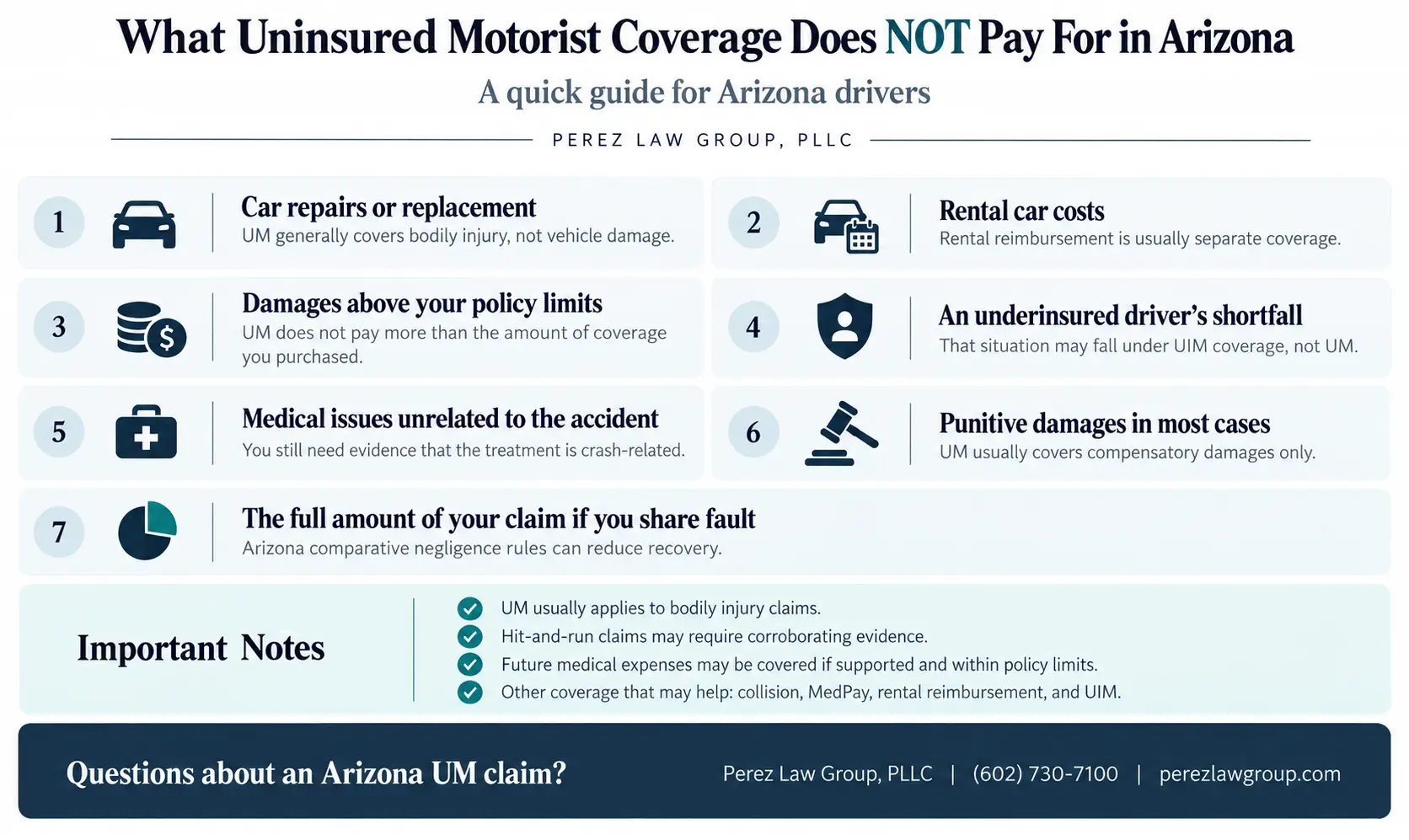
The UM protection described in A.R.S. § 20-259.01(E) addresses bodily injury or death. It should not be treated as a promise to pay for your damaged vehicle.
Ask your insurer to identify which coverage it is evaluating for each loss. Keep repair records separate from medical bills and treatment documentation so the two issues do not become confused. For a broader discussion, see PLG’s article on what uninsured motorist coverage does not pay for in Arizona.
If you receive a denial, keep the letter and ask which policy provision, statutory requirement, or factual dispute the insurer relies on. A denial based on missing corroboration raises different questions from a dispute over injury causation or available policy limits.
Do Not Assume Every Claim Has the Same Deadline
Arizona generally provides a two-year limitations period for personal injury actions under A.R.S. § 12-542, subject to accrual rules and exceptions. An action against another driver and a claim under your own insurance policy should not be treated as interchangeable.
Ask an attorney to identify the deadlines and notice requirements for each potential claim. Do not assume that an open insurance investigation extends a filing deadline, or that waiting for police to identify the other driver protects every claim.
Frequently Asked Questions
Can I pursue a claim if my car never touched the other vehicle?
Potentially. No contact is not an automatic disqualification. The claim still requires proof of its legal elements and applicable coverage. Certain claims involving an unidentified vehicle also require corroboration under A.R.S. § 20-259.01(M).
What if I hit a guardrail while avoiding the other driver?
Contact with a guardrail does not establish contact with the unidentified vehicle. Preserve evidence explaining why you left your path and how the crash happened. An attorney can assess whether the corroboration rule applies and what supports your account.
Is my statement in the police report enough?
Not by itself to satisfy the additional-evidence requirement described in Scruggs. Other information in the report may matter, so the complete report and available supporting records should be reviewed.
Do I need dashcam footage to have a claim?
The statute does not make dashcam footage mandatory. Other testimony, facts, or evidence may provide corroboration. Whether the available material is sufficient depends on what it actually establishes; no category of evidence guarantees recovery.
What should I bring to a consultation?
Bring the report number, photographs, recordings, witness information, insurance declarations, claim correspondence, and available treatment records. A written timeline can also help. Separate what you personally observed from information someone else later told you.
Discuss Your No-Contact Crash With Perez Law Group
If you were injured after swerving to avoid another driver, the lack of contact should not be the end of the investigation. Your account, corroborating evidence, applicable insurance, and medical documentation all deserve careful review.
Perez Law Group, PLLC represents injured people in Glendale, the West Valley, and greater Phoenix. Learn more about the firm’s Glendale car accident practice or contact Perez Law Group at (602) 560-4456 to request a consultation about your circumstances.
This article provides general information, not legal advice for a particular claim. Outcomes depend on the facts, evidence, applicable law, and insurance policy.

Cristina Perez Hesano
Founder & Managing Partner
Cristina Perez Hesano is the founding partner of Perez Law Group, PLLC, and an accomplished Arizona trial attorney with more than a decade of experience. She represents individuals and families in serious personal injury, wrongful death, bankruptcy, and consumer protection matters. Known for her compassion, strategic approach, and dedication to justice, Cristina has successfully secured significant results while helping clients navigate some of life’s most difficult challenges.