How Long Does a Trucking Company Have to Preserve Black Box Data After an Accident?
- What Is Black Box Data in a Commercial Truck?
- How Long Must Trucking Companies Keep Black Box Data Under Federal Law?
- When Does a Trucking Company’s Legal Duty to Preserve Black Box Data Begin?
- Can Truck Black Box Data Be Overwritten After an Accident?
- How Can an Attorney Preserve Black Box Evidence?
- Why Black Box Data Can Change a Truck Accident Investigation
- What Happens If a Trucking Company Destroys Black Box Data?
- How Long Do You Have to Take Legal Action After an Arizona Truck Accident?
- What Should You Do After a Truck Accident to Protect Important Evidence?
- Frequently Asked Questions
- Speak With an Arizona Truck Accident Lawyer Before Critical Evidence Disappears
- There is no universal 30-day or 90-day rule. Federal regulations do not establish one specific retention period for all commercial truck black box data.
- Arizona law requires preservation when litigation is reasonably anticipated. A trucking company cannot necessarily rely on routine deletion policies to justify losing relevant evidence.
- Federal recordkeeping deadlines are different. Driver logging records generally must be kept for six months, while required accident-register records must be maintained for three years.
- Black box evidence can disappear quickly. Some electronic systems may overwrite information during continued vehicle operation, making early preservation efforts important.
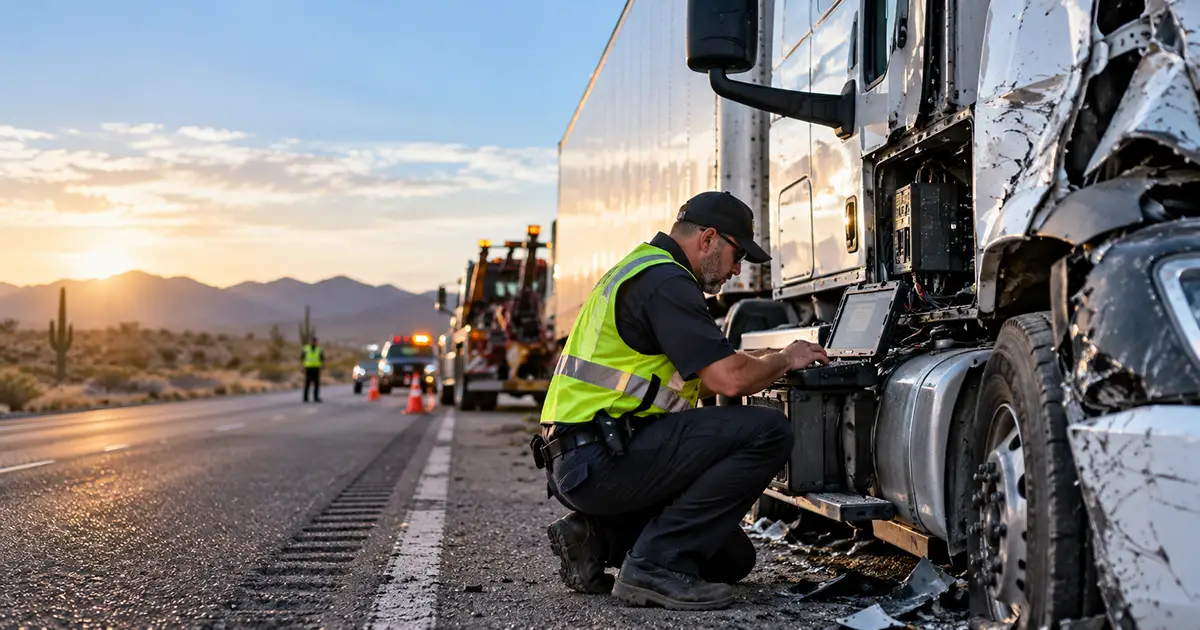
After a serious truck accident, one of the most important witnesses may not be a person. It may be the truck itself.
Many commercial trucks have electronic systems that record information about vehicle speed, braking, engine activity, and other operating conditions. This information, commonly called black box data, can help investigators understand what happened in the moments leading up to a collision. But what happens if the trucking company repairs the vehicle, puts it back on the road, or allows that information to be overwritten?
There is no universal federal deadline requiring trucking companies to preserve black box data for a specific number of days after an accident. However, when a company reasonably anticipates litigation, it may have a legal obligation to preserve relevant electronic evidence, even before someone files a lawsuit.
For people injured in Arizona truck accidents, understanding this distinction can make a significant difference in protecting a potential claim. Waiting too long to investigate could mean losing electronic evidence that helps establish who was responsible.
What Is Black Box Data in a Commercial Truck?
The term “black box” often refers to electronic information stored in a commercial truck’s engine control module (ECM), event data recorder (EDR), or other onboard electronic systems. These devices are not all identical, and the information they capture varies depending on the truck’s manufacturer, model, and installed equipment.
Depending on the system, potentially useful information can include vehicle speed, engine RPM, throttle activity, brake application, sudden deceleration, and certain recorded events. Some systems also maintain engine fault codes and operating information that may help investigators evaluate the truck’s condition before a collision.
Not every truck records all of this information, and some systems do not capture a complete history of an accident. The National Highway Traffic Safety Administration (NHTSA) explains how event data recorders can capture technical information from the moments surrounding certain crashes.
This information becomes especially valuable when a truck driver and an injured motorist give conflicting accounts of what happened. For example, a driver might claim that traffic stopped suddenly and there was no time to react, while available electronic data could reveal whether the truck slowed or whether the brakes were applied before impact.
How Long Must Trucking Companies Keep Black Box Data Under Federal Law?
One of the biggest misconceptions about commercial trucking accidents is that federal law requires trucking companies to retain every type of electronic evidence for six months or three years. Those retention requirements apply to specific records, not necessarily to the truck’s black box crash data.
Six Months for Electronic Driver Logs
Under 49 CFR § 395.8(k)(1), motor carriers generally must retain drivers’ records of duty status and required supporting documents for at least six months. These records help establish how long a driver worked, drove, and rested.
The Federal Motor Carrier Safety Administration (FMCSA) also explains that motor carriers must maintain backup copies of electronic logging device records for six months. However, an electronic logging device (ELD) is not the same thing as a truck’s black box.
An ELD primarily tracks driving activity and hours-of-service compliance, while an ECM or EDR may contain information about vehicle operation or a crash event. Both types of evidence can be important, particularly when investigators suspect that fatigue, speeding, or driver inattention contributed to the collision.
Three Years for Accident Registers
Another federal regulation, 49 CFR § 390.15, requires motor carriers to maintain an accident register for three years. This register includes certain details about qualifying accidents and copies of accident reports required by government entities or insurers.
The three-year rule does not establish a blanket requirement to retain ECM or EDR data for three years. However, a separate legal duty to preserve evidence can require a trucking company to retain relevant electronic information beyond its usual recordkeeping period.
When Does a Trucking Company’s Legal Duty to Preserve Black Box Data Begin?
In Arizona, the duty to preserve electronic evidence is not necessarily triggered by receiving a lawsuit. Under Arizona Rule of Civil Procedure 37(g), a party or person must take reasonable steps to preserve relevant electronically stored information when it reasonably anticipates an action, when it becomes a party to an action, or when it commences one, whichever occurs first.
That means a trucking company’s obligation may arise much earlier than many accident victims realize. A serious crash involving substantial injuries, fatalities, or disputed responsibility could provide circumstances indicating that litigation is reasonably likely.
Consider a collision involving a semi-truck on Interstate 10 near Phoenix that results in serious injuries and an extensive police investigation. Even if the injured person has not hired an attorney, the severity and circumstances of the accident may put the trucking company on notice that litigation is reasonably anticipated.
Once the preservation duty applies, the company must take reasonable steps to prevent routine electronic systems or document retention policies from destroying relevant information. This does not mean every accident creates identical preservation obligations, because the timing and surrounding circumstances must be evaluated individually.
Can Truck Black Box Data Be Overwritten After an Accident?
Yes, depending on the system, stored information may be overwritten, lost during repairs, or become inaccessible. Some electronic modules maintain limited event histories, meaning later vehicle activity may replace certain stored events.
Other systems may retain particular crash information until it is retrieved or the module is altered. There is no reliable universal answer that all truck black boxes overwrite after a particular number of days.
This creates two different timelines following a collision. The technical timeline concerns how long the electronic system actually retains information, while the legal timeline concerns when the company becomes obligated to preserve relevant evidence.
A company may have a legal duty to preserve information even though its equipment would otherwise overwrite the data automatically. This is why waiting several weeks to investigate a serious truck accident can create unnecessary risks.
How Can an Attorney Preserve Black Box Evidence?
One important step after a commercial trucking accident is sending a written evidence preservation notice, sometimes called a spoliation letter. This notice identifies potentially relevant evidence and requests that the company prevent its destruction, alteration, or deletion.
Depending on the circumstances, an attorney may request preservation of:
- ECM, EDR, and other onboard vehicle data
- Electronic driver logs, GPS tracking, and telematics information
- Dash camera footage and dispatch communications
- Vehicle inspection, maintenance, and repair records
- The truck, trailer, and relevant electronic components
A preservation notice may also need to reach the vehicle owner, maintenance provider, insurer, or third-party technology provider. Different companies may control different records, especially when the trucking company uses outside vendors for GPS tracking, fleet management, or vehicle maintenance.
Sending the letter does not automatically give the injured person access to the truck’s computer systems. Obtaining the information may require cooperation, formal discovery, or a court order.
An attorney may also arrange for a qualified accident reconstruction professional to examine and download available electronic data using appropriate equipment. Preserving the original information, documenting how it was collected, and maintaining its integrity can become important if the evidence is challenged during litigation.
Why Black Box Data Can Change a Truck Accident Investigation
Imagine a passenger vehicle is struck from behind by a commercial truck on Interstate 17 in Phoenix. The truck driver tells police that the passenger vehicle stopped unexpectedly, while the injured driver recalls being stopped in traffic for several seconds before the collision.
Without additional evidence, the insurance company may dispute what happened and question whether the truck driver had a reasonable opportunity to avoid the crash. Now suppose investigators recover electronic information indicating that the truck was traveling at highway speed shortly before impact and that no braking activity was recorded during the available pre-impact interval.
That information could support the injured driver’s account and raise questions about the truck driver’s attention and response. Investigators would still need to evaluate the reliability of the data, road conditions, witness statements, and other evidence before reaching conclusions.
This is a hypothetical example, not an actual Perez Law Group case. It illustrates why electronic information can help test competing explanations rather than forcing everyone to rely entirely on memory or assumptions.
Black box evidence may also help establish whether a trucking company failed to maintain equipment or properly supervise its drivers. In some accidents, determining responsibility involves examining the actions of both the driver and the company that employed or controlled the driver.
What Happens If a Trucking Company Destroys Black Box Data?
When a trucking company fails to preserve relevant evidence, the legal issue is commonly called spoliation of evidence. Depending on the circumstances, the loss of important electronic information can create significant consequences during litigation.
Under Arizona Rule of Civil Procedure 37(g), a court may consider remedies when electronically stored information that should have been preserved is lost because reasonable preservation steps were not taken. A court may order additional discovery or other measures addressing prejudice caused by the missing evidence.
More serious consequences, such as instructing a jury to presume that missing evidence was unfavorable to the company, require additional findings, including intent to deprive another party of the information’s use. The loss of black box data does not automatically prove negligence or guarantee that the injured person wins the case.
Courts examine when the preservation duty arose, what reasonable steps were taken, why the information disappeared, and whether the missing evidence can be recovered or replaced. Even when electronic data is unavailable, investigators may still examine surveillance recordings, physical vehicle damage, photographs, witness statements, and other available evidence.
How Long Do You Have to Take Legal Action After an Arizona Truck Accident?
Under Arizona Revised Statutes § 12-542, most personal injury lawsuits must be filed within two years after the cause of action accrues, although exceptions and shorter deadlines may apply. This statute of limitations is separate from the trucking company’s obligation to preserve relevant evidence.
A person might technically have many months remaining to file a lawsuit while electronic evidence that could establish fault is already at risk of disappearing. That is why waiting until the legal filing deadline approaches can be a mistake in a serious trucking accident case.
This is particularly important in collisions involving catastrophic injuries, disputed liability, or multiple companies responsible for operating and maintaining a commercial truck. Early investigation provides a better opportunity to identify relevant electronic systems and request preservation before important information is lost.
What Should You Do After a Truck Accident to Protect Important Evidence?
If you were injured in a collision involving a commercial truck, your first priorities should be obtaining appropriate medical treatment and reporting the accident. When possible, preserve photographs of the vehicles, the trucking company’s name, identifying numbers on the truck, witness information, and any available video.
Avoid assuming that the trucking company’s insurance investigation will preserve everything necessary to support your claim. The company and its insurer may be investigating their own potential liability, and their interests may differ from yours.
An experienced Arizona personal injury attorney can identify potentially important records, evaluate preservation obligations, and take steps to request evidence before it is lost. The sooner that investigation begins, the better the opportunity to determine what electronic information may still be available.
Frequently Asked Questions
Does every semi-truck have a black box?
Not necessarily. Many modern commercial trucks have electronic engine management systems, but their data recording capabilities differ. Not every vehicle has a dedicated crash event recorder or stores the same information.
Can I request black box data directly from the trucking company?
You can request preservation of the information, but obtaining access may require the company’s cooperation, legal discovery, or a court order. A preservation request does not automatically require immediate disclosure of the data.
Does a preservation letter guarantee the data will be saved?
No, a properly directed notice helps establish that relevant evidence has been identified and preservation has been requested. However, it does not guarantee that the information still exists or that the company will comply with its preservation obligations.
Can the trucking company delete data after six months?
The six-month federal recordkeeping requirement applies to certain driver records, not all black box information. If relevant litigation is reasonably anticipated or pending, preservation obligations may require records to be maintained longer than ordinary retention policies specify.
Speak With an Arizona Truck Accident Lawyer Before Critical Evidence Disappears
When a commercial truck accident causes serious injuries, the evidence needed to understand what happened may be stored inside the truck itself. Protecting that information early can make a difference when investigating responsibility and pursuing compensation.
At Perez Law Group, PLLC, our attorneys represent individuals and families injured in serious truck accidents throughout Glendale, Phoenix, and communities across Arizona. We understand the importance of investigating commercial vehicle accidents, identifying potentially responsible parties, and taking appropriate steps to protect evidence.
If you or a loved one was injured in a collision with a commercial truck, speak with Perez Law Group about your legal options. Call (602) 730-7100 or visit PerezLawGroup.com to schedule a free consultation.
This article provides general legal information and is not a substitute for legal advice regarding your individual circumstances. Every truck accident claim is different.

Cristina Perez Hesano
Founder & Managing Partner
Cristina Perez Hesano is the founding partner of Perez Law Group, PLLC, and an accomplished Arizona trial attorney with more than a decade of experience. She represents individuals and families in serious personal injury, wrongful death, bankruptcy, and consumer protection matters. Known for her compassion, strategic approach, and dedication to justice, Cristina has successfully secured significant results while helping clients navigate some of life’s most difficult challenges.