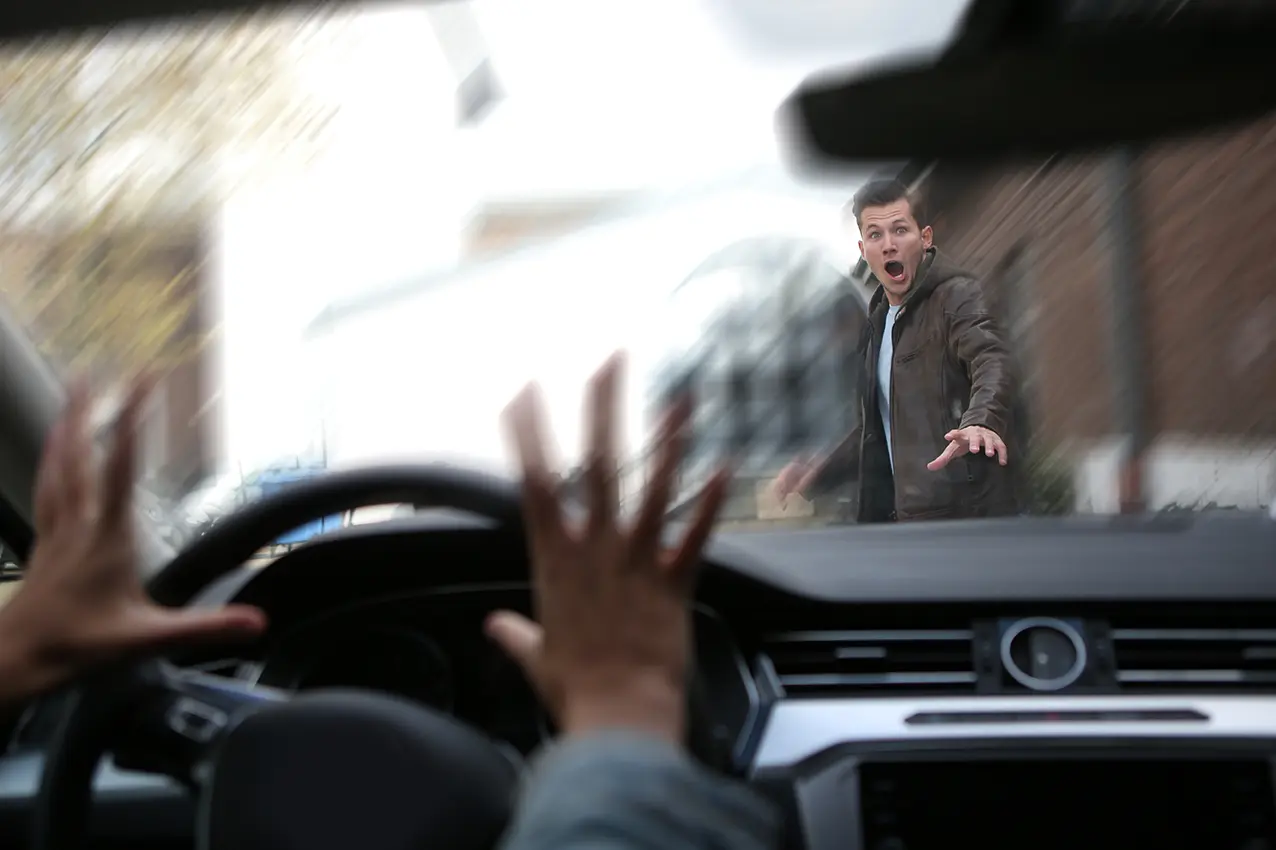
Can a City Be Liable for a Dangerous Crosswalk or Road Design in Arizona?
- Can You Sue a City for an Unsafe Crosswalk in Arizona?
- What Makes a Crosswalk or Road Design Dangerous?
- When Can a City Be Considered Negligent?
- Arizona Law Protects Some Government Road Design Decisions
- A Real Arizona Case Involving a Dangerous Crosswalk
- What Evidence Can Help Prove a Dangerous Roadway Claim?
- Can Both the Driver and the City Be Responsible?
- Important Arizona Deadlines for Claims Against a City
- What Should You Do After an Accident at a Dangerous Crosswalk?
- What Compensation May Be Available?
- Speak With an Arizona Pedestrian Accident Attorney
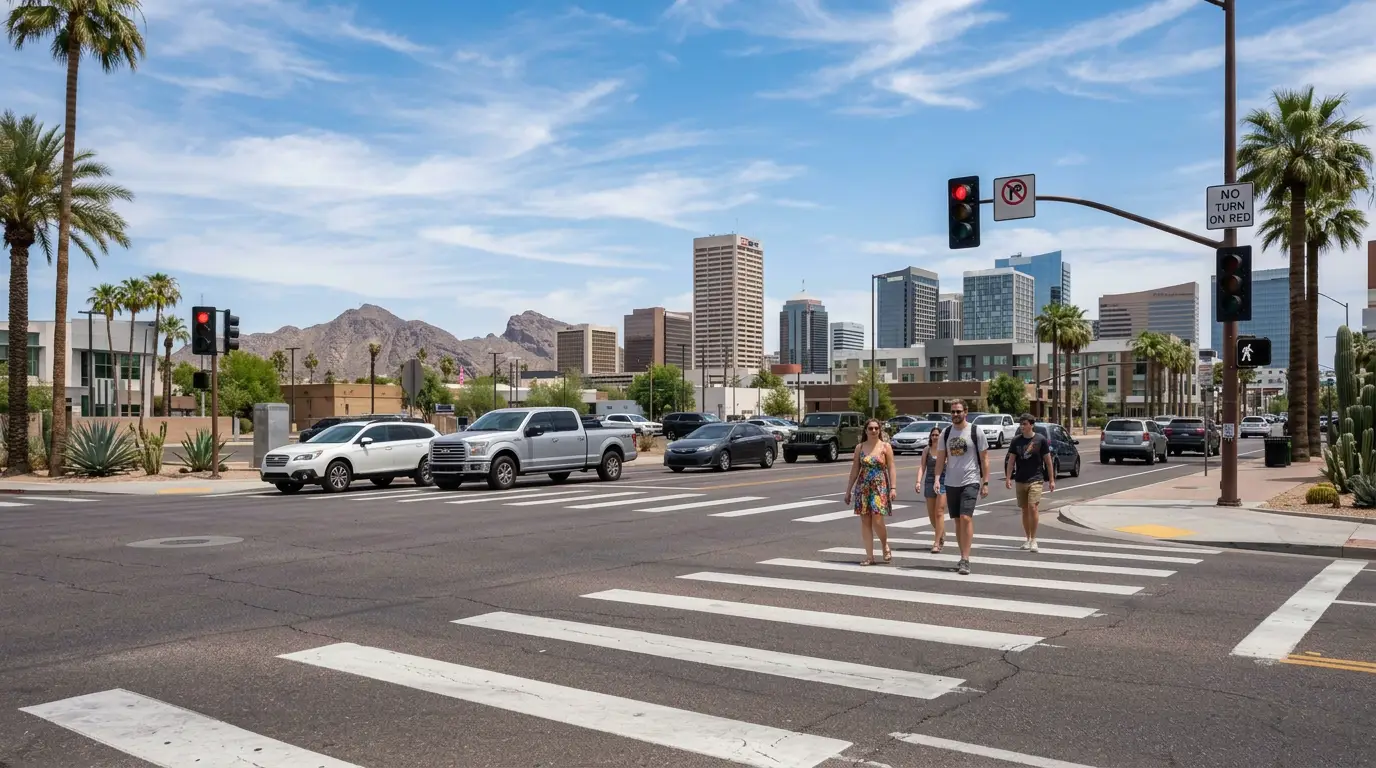
Imagine crossing a busy Glendale street at a marked crosswalk. You wait for traffic, check both directions, and begin walking. Suddenly, a vehicle approaches from a lane where the driver’s view is partially blocked. The driver does not stop, and you are seriously injured.
Most people would immediately focus on the driver. Were they speeding? Were they distracted? Did they fail to yield?
Those are important questions. But there is another question that often gets overlooked: Was the crosswalk itself designed or maintained in a way that made the accident more likely?
In Arizona, a city may be held responsible for injuries caused by dangerous crosswalks, unsafe intersections, or negligent roadway maintenance. However, claims against government entities involve special legal protections and strict deadlines.
Understanding these rules can make a significant difference when determining who should be held accountable for a serious accident.
Can You Sue a City for an Unsafe Crosswalk in Arizona?
Yes. An Arizona city can potentially be held liable when its negligence in designing, maintaining, or managing a roadway creates a dangerous condition that contributes to an accident.
The Arizona Supreme Court recognized in Coburn v. City of Tucson that municipalities have a duty to keep their streets reasonably safe for the traveling public.
That responsibility can extend to pedestrians, bicyclists, and motorists.
However, a city is not automatically responsible simply because someone was injured at an intersection. An injured person generally must establish that the city breached a legal duty, that the breach contributed to the accident, and that the accident caused compensable injuries.
Government immunity laws may also limit or prevent recovery.
At Perez Law Group, PLLC, our approach to personal injury claims includes looking beyond the most obvious explanation for an accident. In a pedestrian collision, that can mean examining whether road conditions contributed to what happened.
What Makes a Crosswalk or Road Design Dangerous?
A painted crosswalk does not necessarily mean a street crossing is reasonably safe.
Some crossings place pedestrians in situations where approaching drivers have limited time or visibility to recognize them.
Dangerous conditions may include:
- Poor visibility: Parked vehicles, landscaping, signs, or other obstructions prevent drivers from seeing pedestrians.
- Inadequate lighting: Crosswalks become difficult to recognize after sunset, especially on busy roads.
- Faded pavement markings: Drivers may not recognize where pedestrians are expected to cross.
- Unsafe crossing distances: Wide intersections force pedestrians to cross several lanes without a refuge island or sufficient crossing time.
- Missing or malfunctioning signals: Broken pedestrian signals or inappropriate traffic controls may create confusion.
- Poorly designed intersections: Road curves, turn lanes, traffic speeds, or sight distances may create foreseeable conflicts between vehicles and pedestrians.
The Federal Highway Administration identifies several proven pedestrian safety improvements, including better lighting, high-visibility markings, pedestrian refuge islands, and rectangular rapid-flashing beacons.
However, the absence of any particular safety improvement does not automatically prove negligence. Whether a city should have installed additional protections depends on the location, applicable engineering standards, known risks, and other circumstances.
When Can a City Be Considered Negligent?
One of the most important questions in a dangerous roadway claim is whether the government entity knew, or reasonably should have known, about a hazardous condition.
Consider a hypothetical crosswalk near a school in Glendale.
Over several years, traffic increases substantially. Drivers routinely travel at higher speeds, residents complain that vehicles fail to stop, and pedestrian collisions occur nearby.
Despite these warning signs, the crossing remains unchanged.
If a pedestrian is eventually injured, the city’s knowledge of the conditions, its response, and any applicable legal defenses may become central issues.
Evidence could include previous complaints, traffic studies, maintenance records, collision reports, or recommendations from city engineers.
The key question is not simply whether the roadway could have been made safer.
It is whether the city failed to meet an applicable legal standard of care and whether that failure contributed to the injury.
Arizona Law Protects Some Government Road Design Decisions
This is where lawsuits involving dangerous road designs become more complicated than ordinary car accident claims.
Under Arizona Revised Statutes § 12-820.03, public entities have an affirmative defense for certain injuries arising from transportation facility plans or designs.
Generally, the defense requires showing that the design complied with accepted engineering or design standards when it was prepared and that the public received reasonably adequate warnings of any unreasonably dangerous condition.
In practical terms, a city may argue that a crosswalk was properly designed under the engineering standards in effect when it was created.
But that does not end every inquiry.
In Glazer v. State, the Arizona Supreme Court explained that the statutory design defense can remain available even when changing traffic conditions make an older roadway substandard.
The Court also emphasized the importance of adequately warning the public about unreasonably dangerous hazards.
This distinction matters. An outdated road is not automatically a negligently designed road, but compliance with original design standards does not eliminate every potential responsibility concerning dangerous conditions.
Arizona law also provides immunity for certain fundamental governmental policy decisions under A.R.S. § 12-820.01.
These protections make it especially important to determine precisely what government action or failure caused the accident.
A Real Arizona Case Involving a Dangerous Crosswalk
One particularly relevant example is the 2023 Arizona Court of Appeals decision in Campion v. City of Tucson.
In 2017, a mother and her son were struck and killed by a vehicle while using a Tucson crosswalk.
A wrongful death lawsuit alleged that the city had negligently replaced a monitored school crosswalk with an unmanned pedestrian crossing years earlier, without conducting an appropriate traffic study.
The plaintiffs argued that this change created an unreasonably dangerous condition.
The city invoked Arizona’s statutory road design defense. A jury found the city was protected, and the Court of Appeals affirmed the judgment.
The case demonstrates how difficult government roadway claims can be, even after devastating accidents.
But it also illustrates an important evidentiary issue.
The appellate court acknowledged that substantially similar pedestrian accidents may be relevant to whether a city should have foreseen a dangerous crosswalk condition. Such evidence must still satisfy rules concerning similarity, disclosure, and admissibility.
The lesson is that a dangerous crosswalk case often depends on engineering evidence, the history of the location, and the government’s legal defenses, not simply on how serious the accident was.
What Evidence Can Help Prove a Dangerous Roadway Claim?
Unlike a typical collision involving two drivers, a roadway design claim may require investigating decisions made years before the accident.
Important evidence may include the original crosswalk designs, traffic studies, city maintenance requests, engineering recommendations, and records of similar crashes.
Photographs are particularly valuable. They can document faded markings, obstructed sightlines, roadway widths, lighting conditions, and the driver’s likely view when approaching the crossing.
It can also help to photograph the location at approximately the same time of day as the accident.
Another important question is who actually controls the roadway.
Not every street in Glendale or Phoenix is maintained by the city. Depending on the location, responsibility might involve a municipality, Maricopa County, the Arizona Department of Transportation, or another entity.
Determining the correct responsible party is essential because different government entities may be involved, and notices must be properly directed.
In complicated cases, accident reconstruction professionals and traffic engineers may help evaluate whether the roadway design or condition contributed to the collision.
Can Both the Driver and the City Be Responsible?
Yes. A pedestrian accident may involve negligence by more than one party.
For example, a driver might fail to yield at a crosswalk while poor visibility or an unsafe roadway condition also contributes to the collision.
The driver’s negligence does not necessarily eliminate the possibility of a claim involving the government entity responsible for the road.
Likewise, Arizona’s comparative negligence rules may affect recovery if the injured pedestrian is found partly responsible.
Under A.R.S. § 12-2505, damages generally may be reduced according to an injured person’s percentage of fault.
Arizona also has specific laws governing pedestrian crossings. Under A.R.S. § 28-792, drivers generally must yield to pedestrians in crosswalks under the circumstances described in the statute.
For more about pedestrian rights and accident investigations, visit our Glendale pedestrian injury lawyer page.
Important Arizona Deadlines for Claims Against a City
One of the biggest mistakes an injured person can make is assuming that a claim against a city has the same filing deadline as an ordinary personal injury lawsuit.
Arizona has special deadlines for claims involving public entities.
The 180-Day Notice of Claim Requirement
Under A.R.S. § 12-821.01, a person generally must file a notice of claim within 180 days after the claim accrues.
The notice must include sufficient facts explaining the basis for liability, a specific amount for which the claim can be settled, and facts supporting that amount.
It must also be properly filed with the person or persons authorized to accept service for the public entity or employee.
Simply reporting an accident to the police or notifying an insurance company does not necessarily satisfy these requirements.
The One-Year Lawsuit Deadline
Under A.R.S. § 12-821, lawsuits against Arizona public entities or public employees generally must be filed within one year after the cause of action accrues.
Exceptions and special accrual rules may apply, including rules involving minors and certain legal disabilities.
Because a defective or late notice can prevent a claim from proceeding, contacting an attorney promptly is especially important when government liability may be involved.
What Should You Do After an Accident at a Dangerous Crosswalk?
If you or a family member suffers an injury at a potentially dangerous intersection, your immediate priority should be medical care.
Once you are safe, preserve any photographs, videos, witness information, and accident documentation that may help establish what happened.
Pay attention to details that might otherwise be overlooked. Was the pedestrian signal working? Was a parked vehicle blocking visibility? Were crosswalk markings faded? Did vehicles in one lane stop while traffic in another lane continued?
Ask that any available surveillance footage be preserved as soon as possible, since recordings may be overwritten.
Avoid assuming that the police report identifies every potentially responsible party. Police investigations often focus on the immediate actions of drivers and pedestrians rather than the roadway’s engineering history.
An attorney can assess whether additional investigation or preservation requests are needed before records disappear.
What Compensation May Be Available?
When a government entity is legally responsible for a pedestrian or roadway accident, an injured person may be entitled to pursue compensation for medical expenses, rehabilitation, lost income, future treatment, pain and suffering, and other legally recoverable losses.
The available compensation depends on the injuries, supporting evidence, applicable law, allocation of fault, and any defenses.
When a dangerous roadway contributes to a fatal accident, eligible surviving family members may also have grounds to pursue a wrongful death claim.
These cases deserve careful evaluation because serious pedestrian injuries can have lasting physical, emotional, and financial consequences.
Speak With an Arizona Pedestrian Accident Attorney
A dangerous crosswalk is not always obvious. Sometimes the real problem involves years of traffic growth, ignored safety concerns, inadequate maintenance, or an intersection that places pedestrians in unnecessary danger.
If you were injured while walking in Glendale, Phoenix, Peoria, or another Arizona community, it may be worth investigating more than the driver’s actions.
At Perez Law Group, PLLC, our legal team represents people injured in pedestrian accidents and other serious personal injury cases. We can review the circumstances, investigate potentially responsible parties, and explain whether a claim involving a public entity may be available.
The sooner a possible government claim is evaluated, the better the opportunity to preserve evidence and address Arizona’s strict notice requirements.
Call Perez Law Group at (602) 730-7100 or visit PerezLawGroup.com to request a free consultation.
This article provides general information about Arizona law and is not legal advice. The outcome of any claim depends on its specific facts and applicable law.

Cristina Perez Hesano
Founder & Managing Partner
Cristina Perez Hesano is the founding partner of Perez Law Group, PLLC, and an accomplished Arizona trial attorney with more than a decade of experience. She represents individuals and families in serious personal injury, wrongful death, bankruptcy, and consumer protection matters. Known for her compassion, strategic approach, and dedication to justice, Cristina has successfully secured significant results while helping clients navigate some of life’s most difficult challenges.