Compensation for Lost Wages After a Vehicle Accident Injury in Arizona

A vehicle accident can affect far more than your health and your car. When an injury prevents you from working, every missed shift can create another financial problem. Rent, mortgage payments, utilities, groceries, and medical bills do not stop simply because you are recovering.
If another person caused the accident, you may be able to pursue compensation for the income and employment benefits you lost. However, receiving lost wage compensation is not automatic. The insurance company will usually expect you to prove how the injury affected your ability to work and exactly how much income you lost.
At Perez Law Group, PLLC, we help injured people throughout Glendale, Phoenix, and other Arizona communities document the full financial impact of vehicle accident injuries. That includes losses that may not appear on a single pay stub, such as overtime, commissions, tips, missed business opportunities, used paid time off, and reduced future earning ability.
What Is Lost Wage Compensation?
Lost wages are earnings you would probably have received if the vehicle accident had not occurred.
The basic idea may sound simple. If you normally earn $1,000 per week and your doctor keeps you out of work for four weeks, your starting wage loss would be $4,000.
Real claims are rarely that simple.
Depending on your job and the evidence available, compensation may include:
- Regular hourly wages or salary
- Overtime you were reasonably expected to work
- Shift differentials
- Tips
- Commissions
- Performance bonuses
- Paid assignments or scheduled projects
- Self-employment income
- Employer retirement contributions
- Lost vacation or sick leave
- Missed raises or promotions
- Reduced future earning capacity
Arizona personal injury claims may seek both lost income and compensation for a reduced ability to earn after a serious injury. Perez Law Group discusses these and other recoverable losses on our Phoenix car accident lawyer page.
Lost Wages and Lost Earning Capacity Are Different
These two terms are often used together, but they describe different losses.
Past Lost Wages
Past lost wages are earnings you already missed between the accident and the resolution of your claim.
Examples include:
- Three weeks missed after surgery
- Reduced hours during physical therapy
- Unpaid time taken for medical appointments
- A missed seasonal work period
- Scheduled overtime that you could not perform
These losses can often be calculated using pay records, schedules, medical restrictions, and employer verification.
Lost Earning Capacity
Lost earning capacity concerns the injury’s effect on your ability to earn money in the future.
You may return to work and still have a lost earning capacity claim. For example, a construction worker with a permanent lifting restriction may return to a lower-paying position. A salesperson with a traumatic brain injury may struggle with concentration, memory, travel, or client presentations. A hairstylist with a shoulder injury may be unable to serve as many clients each day.
The important question is not simply whether you returned to work. It is whether the injury changed what you can reasonably earn over time.
Future earning claims may require medical opinions, employment records, vocational analysis, economic projections, or testimony about your education, skills, career path, and physical limitations.
Our Opinion: Build a Wage Claim Like a Financial Audit
One of the most common mistakes in an injury claim is submitting a short employer letter that says, “This employee missed three weeks.”
That proves an absence. It may not prove the value of the loss.
A strong lost wage claim should connect every claimed dollar to two things:
- A medical reason you could not perform your work
- A financial record showing what you probably would have earned
We call this the two-link rule. If either link is missing, the insurance company may challenge the claim.
For example, pay stubs may show that you stopped receiving income, but the insurer may argue that the absence was voluntary if there is no medical restriction. A doctor’s note may establish that you could not work, but it does not show your usual pay, overtime, or commissions.
The strongest claims bring both sides of the evidence together.
What Documents Can Prove Lost Wages?
Do not depend on a single pay stub or a verbal statement from your supervisor. Create a lost wage proof file as soon as you realize the injury will affect your employment.
Medical Evidence
Useful medical evidence may include:
- A doctor’s work restriction
- A note taking you completely off work
- Restrictions on lifting, standing, driving, bending, or computer use
- Records of surgeries and medical appointments
- Physical therapy schedules
- Recommendations for reduced hours
- Permanent impairment or disability evaluations
Ask the medical provider to be specific. A statement saying “light duty” may create confusion unless it explains what tasks you cannot perform.
Employment Evidence
Employment records can establish your position and normal earnings:
- Pay stubs from before and after the accident
- Time sheets
- Work schedules
- Payroll summaries
- W-2 forms
- Employment contracts
- Offer letters
- Overtime history
- Commission statements
- Bonus plans
- Documentation of employer retirement contributions
An employer verification letter should ideally identify your job title, pay rate, regular schedule, missed dates, missed hours, overtime history, commissions, bonuses, and paid leave used because of the injury.
Personal Records
Your own records can help fill gaps:
- A calendar of missed shifts
- Emails or text messages with your supervisor
- Appointment confirmations
- Bank deposit history
- Screenshots from a scheduling application
- Notes describing attempted work and increased symptoms
- Records of transportation problems caused by the injury
A simple daily record can become valuable months later, especially when medical appointments and partial workdays are involved.
How Lost Income May Be Calculated
The calculation method depends on how you are paid.
| Type of worker | Possible calculation method | Helpful evidence |
|---|---|---|
| Hourly employee | Missed hours multiplied by hourly rate | Pay stubs, time sheets, schedules |
| Salaried employee | Daily or weekly salary multiplied by time missed | Salary records, employer letter |
| Overtime worker | Regular wages plus documented expected overtime | Prior pay stubs, schedules, overtime history |
| Commission employee | Historical average adjusted for expected sales | Commission statements, sales pipeline, prior-year records |
| Tipped employee | Recorded wages plus supported average tips | Payroll records, tip reports, tax returns |
| Gig worker | Historical average earnings during comparable periods | App statements, deposits, mileage records |
| Business owner | Lost net profit and reasonable replacement costs | Tax returns, invoices, contracts, business records |
The calculation should reflect what you probably would have earned, not merely the highest amount you earned during an unusually successful week.
Can You Recover Overtime, Tips, Bonuses, and Commissions?
Potentially, but these amounts need support.
An insurer may argue that overtime, commissions, bonuses, and tips are speculative. The best response is usually a consistent historical record.
Suppose you worked overtime during 10 of the 12 weeks immediately before the accident. Your schedules and pay stubs may support an argument that overtime was a regular part of your earnings.
A salesperson may use past commission statements, pending contracts, client communications, and performance history. A restaurant employee may use payroll records, tip reports, shift schedules, and tax returns.
The goal is not to prove the future with complete certainty. It is to provide reliable evidence showing what was reasonably expected.
What If You Used Sick Leave or Paid Time Off?
Receiving paid leave does not necessarily mean the accident caused no financial loss.
You earned that leave as an employment benefit. Because of the injury, you may have been forced to use days that would otherwise have remained available for illness, family needs, or vacation.
Keep records showing:
- How much leave you had before the accident
- How much leave was used
- The dates it was used
- Whether the leave has a cash or rollover value
- Whether the employer required you to use it
- Whether your leave balance affected another benefit
The value and recoverability of used leave depend on the circumstances, but it should not be ignored simply because your paycheck continued temporarily.
Eligible employees may also have rights under the federal Family and Medical Leave Act. FMLA can provide unpaid, job-protected leave for qualifying medical conditions, but it does not replace the wages you lose. FMLA may run at the same time as employer-provided paid leave.
Proving Lost Income When You Are Self-Employed
Self-employed people often face more resistance because their income may vary from month to month. That does not mean the loss is impossible to prove.
Useful evidence may include:
- Business and personal tax returns
- Profit and loss statements
- Bank records
- Customer invoices
- Signed contracts
- Appointment calendars
- Estimates and proposals
- Canceled job records
- Customer emails and text messages
- Payment processor statements
- Evidence of seasonal income patterns
- Payments made to replacement workers
Gross revenue and lost profit are not always the same. If a contractor lost a $10,000 project but would have spent $4,000 on materials and subcontractors, claiming the entire $10,000 as personal income may overstate the loss.
A better analysis may consider the expected net profit, fixed expenses that continued during recovery, and reasonable amounts paid to replacement workers.
Three Illustrative Lost Wage Examples
The following composite examples are provided for educational purposes. They do not describe specific Perez Law Group clients or guarantee a particular result.
Example 1: The Hourly Employee With Regular Overtime
An emergency department technician earns $24 per hour and normally works three 12-hour shifts each week. Her pay records also show an average of eight overtime hours every two weeks.
A crash-related shoulder injury prevents her from lifting patients for six weeks. Her employer cannot provide light duty.
A complete claim would not stop at her base hourly wages. It would also document her regular schedule, overtime history, shift differential, medical lifting restriction, and any paid leave she was required to use.
Example 2: The Self-Employed Landscaper
A landscaper fractures his wrist and cannot perform physical work for eight weeks. Several customers cancel recurring services, and he pays another worker to complete two contracted projects.
A weak claim would simply estimate how much money he usually makes in two months.
A stronger claim would compare revenue from the same months in prior years, review existing contracts, identify canceled customers, calculate expected net profit, and document the cost of replacement labor.
Example 3: The Employee Who Returned Too Soon
An office manager returns to work after one week because she cannot afford to remain home. She continues experiencing headaches and concentration problems after a collision.
She uses unpaid time for neurological appointments, works shorter days, and loses a quarterly performance bonus because she cannot complete a major project.
Her wage claim may include more than the first week she missed. It may also involve reduced hours, appointment time, the lost bonus, and evidence that her continuing limitations affected her job performance.
Returning to work does not automatically end a lost income claim.
Who Pays Lost Wages After a Vehicle Accident?
The responsible driver’s bodily injury liability insurance is often the first potential source of compensation. However, other policies or responsible parties may be involved.
Depending on the accident, compensation may come from:
- The at-fault driver’s insurer
- The vehicle owner’s policy
- A commercial automobile policy
- An employer whose employee caused the crash while working
- A rideshare or delivery company policy
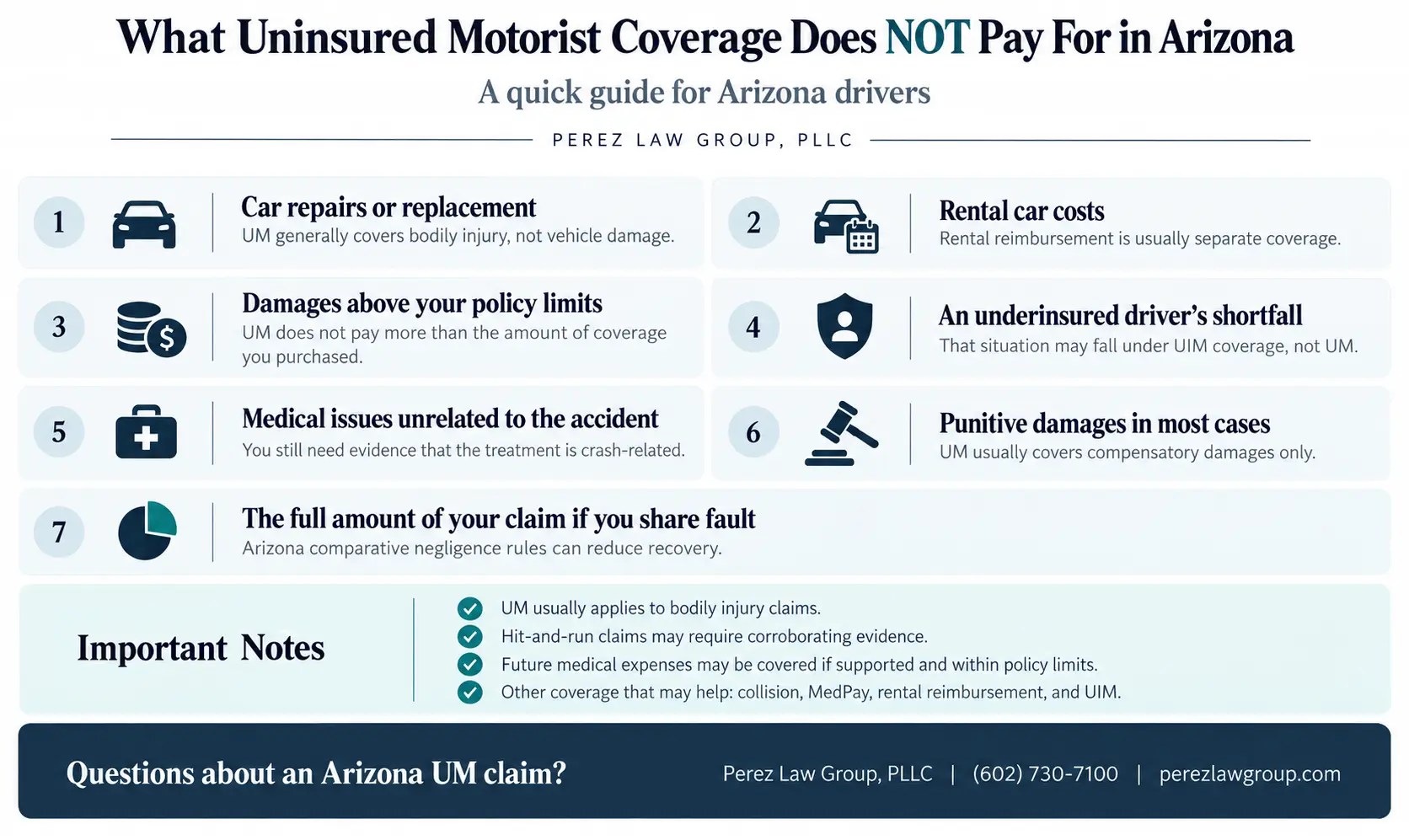
- Your uninsured motorist coverage
- Your underinsured motorist coverage
- Another business or entity that contributed to the collision
The liability insurer generally evaluates lost income as part of the overall bodily injury claim. It usually does not send weekly replacement paychecks while you recover. This is one reason injured people should carefully plan for medical bills and income interruptions while the claim is being investigated. Learn more in our guide explaining how to file an insurance claim for accident-related medical bills.
When an at-fault driver has no insurance or inadequate limits, your own coverage may become important. Perez Law Group provides additional guidance about accidents involving uninsured drivers and medical expenses that exceed the responsible driver’s policy limits.
What If You Were Partially Responsible for the Accident?
Arizona follows a comparative fault system. Being partially responsible for a collision does not automatically prevent you from recovering compensation. However, your damages may be reduced according to your percentage of fault.
For example, if your total proven damages were $100,000 and you were found 20 percent responsible, the award could be reduced to $80,000.
You can review Arizona’s comparative negligence rule in A.R.S. § 12-2505.
Five Mistakes That Can Weaken a Lost Wage Claim
1. Returning to Work Against Medical Advice
Returning too early can worsen your injury. It may also allow the insurer to argue that you were medically capable of working.
2. Failing to Request Written Restrictions
A verbal recommendation to “take it easy” is difficult to prove. Ask your provider to document specific limitations and the dates they apply.
3. Estimating Income Without Records
Round-number estimates may appear unreliable. Use payroll records, tax documents, schedules, bank deposits, and employer verification whenever possible.
4. Ignoring Partial Work Losses
A wage claim can include reduced hours, unpaid appointment time, missed overtime, lost commissions, and other income disruptions. It is not limited to full days away from work.
5. Signing a Settlement Before Understanding the Future
A settlement normally closes the claim. If your doctor later determines that you need surgery, permanent restrictions, or a career change, you may not be able to request additional compensation.
How Long Do You Have to File a Lost Wage Claim?
Under A.R.S. § 12-542, most Arizona personal injury lawsuits must be filed within two years after the injury. Missing the deadline may eliminate your ability to recover damages, including lost income.
Special deadlines can be much shorter when a government entity or public employee may be responsible. Arizona law generally requires a notice of claim within 180 days, and actions against a public entity or employee generally must be brought within one year. These rules may apply to crashes involving government vehicles, public transportation, or dangerous public road conditions. See A.R.S. § 12-821.01 and A.R.S. § 12-821.
There can be exceptions and additional deadlines, so do not assume that you have two full years in every situation. Perez Law Group explains this issue further in our article about the Arizona auto accident statute of limitations.
Are Lost Wage Settlements Taxable?
Tax treatment depends on why the payment was made and how the settlement is structured.
The IRS generally states that compensatory damages received because of a personal physical injury or physical sickness may be excluded from gross income. Exceptions can apply, including punitive damages and certain medical expenses previously claimed as tax deductions.
Review the IRS guidance regarding the tax implications of settlements and judgments, and speak with a qualified tax professional about your specific settlement.
How Perez Law Group Can Help With a Lost Wage Claim
A lost wage claim should reflect the real effect the injury had on your financial life. That may require more than collecting a few pay stubs.
Perez Law Group can help investigate the accident, communicate with insurance companies, obtain employment documentation, organize income records, identify available insurance coverage, and evaluate both current and future earning losses.
Our attorneys handle vehicle accident cases involving hourly workers, salaried employees, commissioned professionals, gig workers, business owners, and people whose injuries may permanently change their careers.
If you were injured in a vehicle accident in Glendale, Phoenix, or another Arizona community, contact our Glendale car accident attorneys before accepting an insurance settlement that may not include your full wage loss. Perez Law Group has obtained significant results in serious auto injury and wrongful death matters, although every case is different and prior results do not guarantee a similar outcome.
Call Perez Law Group, PLLC at (602) 730-7100 or contact our office online to schedule a consultation.

Cristina Perez Hesano
Founder & Managing Partner
Cristina Perez Hesano is the founding partner of Perez Law Group, PLLC, and an accomplished Arizona trial attorney with more than a decade of experience. She represents individuals and families in serious personal injury, wrongful death, bankruptcy, and consumer protection matters. Known for her compassion, strategic approach, and dedication to justice, Cristina has successfully secured significant results while helping clients navigate some of life’s most difficult challenges.